
Atteva aurea
(Fitch, 1856)
Ailanthus Webworm Moth, Ermine Moth
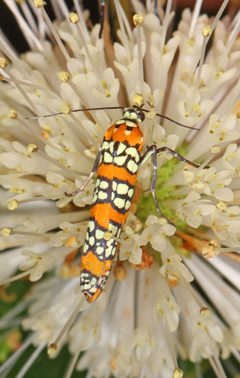
Atteva aurea, commonly known as the ailanthus webworm or , is a small, colorful moth native to Central America and the southern United States that has expanded its range northward following the introduction and spread of its plant, the Tree of Heaven (Ailanthus altissima). The moth displays striking orange, black, and white coloration and is active during daylight hours, feeding on nectar from flowers such as ageratum. The larval stage, known as the ailanthus webworm, constructs communal silken webs on host plants and feeds on leaves, with the potential to defoliate small trees. The has been proposed as a potential agent for the invasive Tree of Heaven.
Pronunciation
How to pronounce Atteva aurea: /æˈtɛvə ˈɔːriə/
These audio files are automatically generated. While they are not always 100% accurate, they are a good starting point.
Identification
Distinguished from other small by its activity and striking orange-black-white color pattern. At rest, may be mistaken for a or true due to its compact, flattened posture. In , -like appearance and rapid, erratic movement help distinguish it from other moths. The larval stage is identified by its communal silken webbing on Simaroubaceae plants, particularly Ailanthus altissima. Similar in the Atteva occur in Central and South America but differ in distribution and host associations.
Images
Appearance
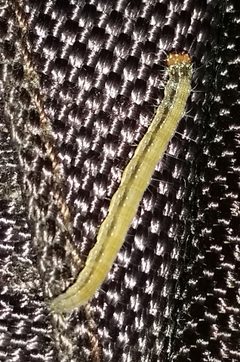
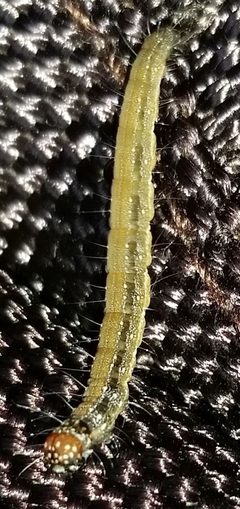
are small with a wingspan of approximately 18–25 mm. The forewings display a distinctive pattern of orange, black, and white arranged in bands and spots, creating an ermine-like appearance. The body is slender and similarly colored. At rest, the moth holds its wings flat and tight against the body, giving it a somewhat -like or true -like profile. In , the moth resembles a due to its rapid, darting movements and coloration. The larvae are snaky, yellowish-green caterpillars with dark stripes.
Habitat
Open, sunny areas including gardens, meadows, fields, and urban environments where plants occur. Associated with disturbed and areas where Tree of Heaven has become established. Larval habitat consists of the foliage and stems of host plants in the Simaroubaceae.
Distribution
Native to Central America and the southern United States. Range has expanded northward throughout the eastern and central United States and into southern Canada (including Ontario), following the spread of the plant Ailanthus altissima. Present in urban and suburban environments across its range.
Seasonality
are active from late summer through autumn in northern parts of the range; may have multiple or year-round activity in southern regions. Larvae present in late summer and early autumn when they construct webs and feed on plant foliage. In northern states, may not survive winter and rely on recolonization by migrating adults from southern populations.
Diet
feed on nectar from flowers, including ageratum (Eupatorium coelestinum), milkweed, dogbane, and other late-season blooming plants. Larvae feed on leaves of plants in the Simaroubaceae, including Ailanthus altissima (Tree of Heaven) and Simarouba glauca (Paradise tree).
Host Associations
- Ailanthus altissima - primary larval Tree of Heaven; introduced that enabled northward range expansion
- Simarouba glauca - native larval Paradise tree; native in Florida and Central America
- Eupatorium coelestinum - nectar sourcehardy ageratum; important late-season nectar plant
Life Cycle
Complete with four stages: , larva, pupa, and . Females lay eggs in clusters on leaves of plants. Larvae hatch and construct communal silken webs from which they forage on leaves. Multiple larvae may share a web. occurs within the web or in surrounding debris. In northern portions of the range, adults migrate from southern areas each spring and summer.
Behavior
are and active during daylight hours, unusual for many . They are vagabonds that migrate annually from southern areas to northern breeding grounds. Larvae exhibit communal nesting , constructing shared silken webs. When disturbed, larvae writhe inside their webs. Adults are attracted to flowers for nectar feeding and may be important of late-season blooming plants.
Ecological Role
Larval herbivore that defoliates plants, with potential to suppress Tree of Heaven . of late-season flowers. May serve as prey for various including birds, spiders, and . Proposed as agent for invasive Ailanthus altissima.
Human Relevance
Considered a potential agent for the Tree of Heaven (Ailanthus altissima), which is a problematic weed tree in urban and natural areas. The 's ability to defoliate and kill small Tree of Heaven saplings has generated interest in its use for invasive plant management. moths are visually striking and contribute to garden biodiversity. No significant negative economic impacts reported; not a pest of agricultural crops.
Similar Taxa
- Atteva nivosaSimilar appearance and ; occurs in Central and South America with different associations and distribution
- Cisseps fulvicollisYellow-collared scape moth; similar activity, orange and black coloration, and late-season period, but belongs to Erebidae and has different wing pattern and body shape
- Syntomeida epilaisPolka-dot wasp moth; similar -mimicking appearance and , but larger with different color pattern (blue-black with white polka dots)
Sources and further reading
- BugGuide
- GBIF taxonomy match
- iNaturalist taxon
- NCBI Taxonomy
- Catalogue of Life
- Watch out Tree of Heaven, native and invasive insects are ready to wage war on you: Ailanthus webworm, Atteva aurea, and spotted lanternfly, Lycorma delicatula — Bug of the Week
- Stylish Lepidoptera: Ermine Moth, Atteva aurea; Yellow-Collared Scape Moth, Cisseps fulvicollis; Pearl Crescent, Phyciodes tharos; Variegated Fritillary, Euptoieta claudia — Bug of the Week
- Bug Eric: Last Night to Blacklight?
- Archive — Bug of the Week
- Bladderwort: How a Carnivorous Plant Could Be Used in Mosquito Control
- When hardcore botany meets hardcore nature photography—nature geekery at its finest! | Beetles In The Bush
- NOTE ON THE DISTRIBUTION OF ATTEVA AUREA FITCH
- Hosts, Morphological Notes, Distribution Records, and Systematics of Three Common Honduran Moths, Atteva aurea (Attevidae), Mesophleps adustipennis (Gelechiidae), and Hyblaea puera (Hyblaeidae)