
Cisseps fulvicollis
Hübner, 1818
Yellow-collared Scape Moth
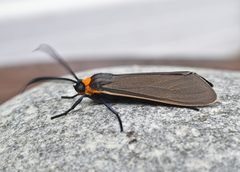
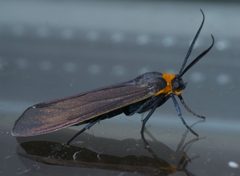
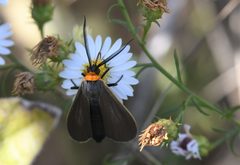
Cisseps fulvicollis, the yellow-collared scape , is a member of the tiger moth Arctiinae. are distinguished by a bright yellow or orange collar on a black body, with wingspan ranging 25–38 mm. The is active during daylight hours, feeding on nectar and pollen. Larvae feed nocturnally on grasses and sedges. It is widespread across North America from Canada to Texas and Florida.
Pronunciation
How to pronounce Cisseps fulvicollis: //ˈsɪsɛps ˌfʊlvɪˈkɒlɪs//
These audio files are automatically generated. While they are not always 100% accurate, they are a good starting point.
Identification
Distinguished from similar dark by the bright yellow or orange collar on the . The Virginia ctenucha (Ctenucha virginica) is similar in appearance but has different geographic distribution—C. fulvicollis occurs in the southeastern US where C. virginica is absent. are , unlike many moth .
Images
Habitat
Fields, forest edges, gardens, and meadows. Associated with areas where larval plants (grasses and sedges) are present.
Distribution
North America from Canada (Alberta, Manitoba, Saskatchewan) south through the United States to Texas and Florida. Widespread throughout eastern and central North America.
Seasonality
Active late spring through summer, with peak activity in late summer and autumn. are and may be observed feeding during daylight hours.
Diet
feed on nectar and pollen. Larvae feed on grasses (Poaceae) and sedges (Cyperaceae).
Host Associations
- grasses - larval food plantPoaceae
- sedges - larval food plantCyperaceae
Life Cycle
Females lay on grasses and sedges. Caterpillars are yellow, brown, or black with sparse long, soft pale setae, bearing dark stripes on back and sides surrounded by yellow or orange stripes. Larvae feed nocturnally. and details are not well documented.
Behavior
are , actively feeding on nectar during daylight hours. This contrasts with the habits of many related . Larvae feed at night and are rarely observed.
Ecological Role
serve as when feeding on nectar. Larvae function as herbivores on grasses and sedges. The is part of the tiger moth clan, many of which employ aposematic coloration as a defense strategy.
Human Relevance
Considered a beneficial in gardens and meadows. No known negative economic impact. The aposematic coloration makes it a subject of interest for naturalists and photographers.
Similar Taxa
- Ctenucha virginicaSimilar dark body with bright markings; distinguished by geographic separation (C. virginica absent from southeastern US where C. fulvicollis occurs) and structural differences in and wing shape
More Details
Sources and further reading
- BugGuide
- Wikipedia
- GBIF taxonomy match
- iNaturalist taxon
- NCBI Taxonomy
- Catalogue of Life
- Stylish Lepidoptera: Ermine Moth, Atteva aurea; Yellow-Collared Scape Moth, Cisseps fulvicollis; Pearl Crescent, Phyciodes tharos; Variegated Fritillary, Euptoieta claudia — Bug of the Week
- Archive — Bug of the Week
- Aposematic autumn moths: Yellow-collared scape moth, Cisseps fulvicollis, and Ermine moth, Atteva aurea — Bug of the Week