
Ctenucha virginica
Esper, 1794
Virginia Ctenucha, Virginia Ctenucha Moth
Ctenucha virginica is a tiger moth in the Erebidae, notable for its -mimicking appearance. The exhibits striking metallic blue-green body coloration with yellow-orange and black to olive-brown wings. It is to eastern North America with documented westward range expansion into the Canadian Rockies. Both larvae and are active feeders, with caterpillars consuming grasses, irises, and sedges while adults visit flowers for nectar.
Pronunciation
How to pronounce Ctenucha virginica: //təˈnuːkə vərˈdʒɪnɪkə//
These audio files are automatically generated. While they are not always 100% accurate, they are a good starting point.
Identification
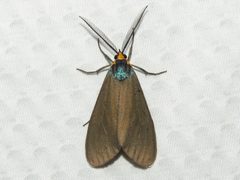
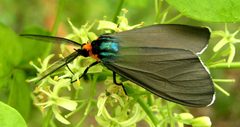
Distinguished from similar -mimicking by combination of metallic blue-green body and yellow-orange . Cisseps fulvicollis (yellow-collared scape moth) has yellow collar rather than yellow-orange head. Harrisina americana (grapeleaf skeletonizer) has different body shape and color pattern. Clearwing moths (Sesiidae) have transparent wings and more slender wasp-like build.
Images
Appearance
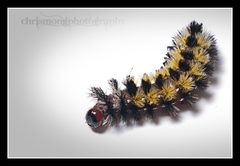
Medium-sized with wingspan 40–50 mm. Wings black to olive-brown. Body metallic blue-green. yellow-orange with feathery . Caterpillar 20–25 mm with multiple tufts of white and yellow hair.
Distribution
Eastern North America from Newfoundland south to Virginia. Westward expansion documented: now found in all Canadian provinces including Alberta, Manitoba, Saskatchewan, and reaches Canadian Rockies.
Seasonality
occurs May–August. active during day, particularly on flowers.
Diet
Larvae feed on grasses, irises, and sedges. drink nectar from flowers including goldenrod.
Life Cycle
Complete . Caterpillar stage 20–25 mm with white and yellow hair tufts. and May–August.
Behavior
activity pattern unusual for . visit flowers for nectar. Considered a mimic, potentially gaining protection from through resemblance to stinging insects.
Ecological Role
nectar feeding may contribute to pollination. Larval herbivory on grasses, irises, and sedges. mimicry suggests aposematic or protective function in .
Human Relevance
Occasionally documented in gardens. Subject of entomological study due to mimicry and .
Similar Taxa
- Cisseps fulvicollisYellow-collared scape moth with similar -mimicking form but distinguished by yellow collar marking
- Harrisina americanaGrapeleaf skeletonizer with metallic coloration but different body proportions and larval on grape
- Sesiidae (clearwing moths) mimics with transparent wings and more slender build, active in similar
Sources and further reading
- BugGuide
- Wikipedia
- GBIF taxonomy match
- iNaturalist taxon
- NCBI Taxonomy
- Catalogue of Life
- 'Bee' One in a Million | Bug Squad
- The Insects Around Us: From UC Davis Picnic Day to Your Computer | Bug Squad
- Ready for the Virtual Moth Open House at the Bohart Museum of Entomology? | Bug Squad
- Curator Jeff Smith: Spreading the Wings of Butterflies | Bug Squad
- Bug Eric: Wasp Wednesday: Not Wasp VIII
- Monday Moth – Polka-dot Wasp Moth | Beetles In The Bush