
Ctenucha
Kirby, 1837
ctenucha moths
Species Guides
6- Ctenucha brunnea(Brown Ctenucha)
- Ctenucha cressonana(Cresson's ctenucha)
- Ctenucha multifaria(White-margined Ctenucha Moth)
- Ctenucha rubroscapus(red-shouldered ctenucha moth)
- Ctenucha venosa(Veined Ctenucha Moth)
- Ctenucha virginica(Virginia Ctenucha)
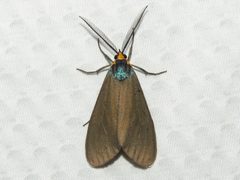
Ctenucha is a of tiger moths in the Erebidae, historically classified in family . The genus name derives from Greek, meaning "having a comb," referring to the showy of some . are frequently observed visiting flowers for nectar, particularly goldenrod in autumn. Many species exhibit aposematic coloration and -like appearance, serving as Müllerian mimics. The genus contains over 50 described species distributed primarily in the Americas.

Pronunciation
How to pronounce Ctenucha: //tɛˈnuːkə//
These audio files are automatically generated. While they are not always 100% accurate, they are a good starting point.
Identification
Ctenucha can be recognized by their activity, -like appearance, and often metallic blue-black coloration with contrasting markings. The are notably showy in many species, with the name referencing their comb-like structure. lack the narrow waist of true wasps but possess similar bold color patterns. The Virginia Ctenucha (Ctenucha virginica) is common east of the Rocky Mountains and serves as a representative example of the genus's general .
Images
Distribution
of Ctenucha are distributed across the Americas. Ctenucha virginica occurs east of the Rocky Mountains in North America. Ctenucha rubroscapus (red-shouldered ctenucha) is found in California coastal areas. Multiple species occur in Central and South America, with records from Argentina, Brazil, and other countries. The is most diverse in the New World tropics.
Seasonality
are active during daylight hours, particularly in late summer and autumn. Ctenucha virginica and related are frequently observed on goldenrod flowers during fall. Activity patterns vary by species and latitude.
Behavior
are , visiting flowers for nectar. They exhibit -mimicry, with coloration and patterns that resemble stinging Hymenoptera. This mimicry is considered aposematic, warning of unpalatability or . The hover at flowers rather than landing, a shared with some wasp .
Human Relevance
Ctenucha are subjects of ecological and behavioral research due to their mimicry systems. They are featured in entomological collections and educational programs. Ctenucha rubroscapus is among specimens curated at the Bohart Museum of Entomology, where it has been used in demonstration of spreading techniques. The serves as an accessible example of Batesian/Müllerian mimicry for public education.
Similar Taxa
- SyntomeidaRelated tiger moths in Erebidae that also exhibit -mimicry and aposematic coloration; historically classified together in Ctenuchidae
- Sesiidae (clearwing moths)Also mimics with habits, but possess transparent wings and different body structure; larvae are stem borers rather than external feeders
- Zygaenidae (leaf-skeletonizer moths)Some mimic or toxic beetles, but have different wing venation and larval habits (leaf skeletonization)
- Amata (maidens)Related erebid with similar -like appearance, restricted to Old World; share tribal relationship with Ctenucha
More Details
Taxonomic History
The has undergone significant taxonomic revision. Historically placed in Ctenuchidae, then subsumed into , then Noctuidae, and now resides in Erebidae following Lafontaine and Schmidt (2010). The former family Ctenuchidae is no longer recognized.
Etymology
The name was coined by William Kirby from Greek 'ktenos' (comb) and 'echo' (have), referring to the comb-like or showy characteristic of some .
Species Diversity
The contains at least 50 described , with Ctenucha virginica, Ctenucha rubroscapus, Ctenucha multifaria (California ctenucha), Ctenucha brunnea (brown ctenucha), and Ctenucha venosa (veined ctenucha) among those with established .
Sources and further reading
- BugGuide
- Wikipedia
- GBIF taxonomy match
- iNaturalist taxon
- NCBI Taxonomy
- Catalogue of Life
- 'Bee' One in a Million | Bug Squad
- The Insects Around Us: From UC Davis Picnic Day to Your Computer | Bug Squad
- Ready for the Virtual Moth Open House at the Bohart Museum of Entomology? | Bug Squad
- Curator Jeff Smith: Spreading the Wings of Butterflies | Bug Squad
- Bug Eric: Wasp Wednesday: Not Wasp VIII
- Noctuidae | Beetles In The Bush | Page 3