
Yponomeuta cagnagella
(Hübner, 1813)
Spindle Ermine, Spindle Ermine Moth
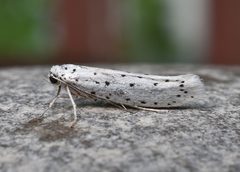
Yponomeuta cagnagella, the spindle ermine moth, is a small ermine moth in the Yponomeutidae with a wingspan of 19–26 mm. are white with distinctive black dot patterns on the forewings and dark grey hindwings. The is notable for its larval habit of producing extensive protective webbing on plants and has been studied for urban to light pollution.
Pronunciation
How to pronounce Yponomeuta cagnagella: //ˌɪp.nəˈmjʊː.tə ˌkæn.jəˈɡɛl.jə//
These audio files are automatically generated. While they are not always 100% accurate, they are a good starting point.
Identification
Distinguished from other Yponomeuta by forewing pattern: four longitudinal series of black dots with specific arrangement (first series not reaching middle, second beginning near before middle, lowest with 4–7 dots). Distinguished from Y. plumbella and Y. irrorella by specific dot configuration and association with European spindle as . Dark grey hindwings contrast with white forewings. Larval webbing on spindle branches is characteristic.
Images
Appearance
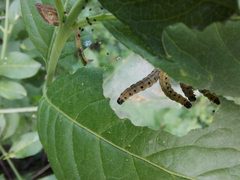
have white forewings with four longitudinal series of black dots; the first series does not reach the middle of the wing, the second begins near before the middle, and the lowest series contains 4–7 dots. Additional black dots appear before the termen. The hindwings are dark grey. The is white, and wing cilia are white. Wingspan ranges from 19 to 26 mm. Larvae are pale greyish-yellow with black spots and a black head.
Seasonality
period from end of June to October.
Diet
Larvae feed on European spindle (Euonymus europaeus).
Host Associations
- European spindle - larval food plantEuonymus europaeus; shared with Y. plumbella and Y. irrorella
Life Cycle
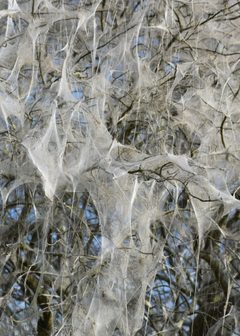
Larvae produce extensive protective webbing covering branches of plants. occurs within slightly transparent, grid-like silk cocoons consisting of a single layer of thin silk filaments (2.6–2.8 µm diameter, arranged in doublets). Cocoons have relatively low adhesive content compared to other .
Behavior
are attracted to light, though urban show significantly reduced -to-light compared to rural populations due to in light-polluted environments. Females in all populations show lower light attraction than males. During occasional , larvae can defoliate entire trees and cover them with silk within days.
Human Relevance
Used as model organism in studies of urban evolution and light pollution . Subject of genomic and silkomics research due to its phylogenetic position as an early diverging ditrysian lepidopteran. Larval can cause aesthetic damage to ornamental spindle plantings through webbing and defoliation.
Similar Taxa
- Yponomeuta plumbellaShares European spindle as plant; distinguished by different forewing dot pattern
- Yponomeuta irrorellaShares European spindle as plant; distinguished by different forewing dot pattern
More Details
Silk composition
Silk glands show three-part (, middle, silk glands). Major silk components include fibroin heavy chain (H-Fib), light chain (L-Fib), fibrohexamerin (Fhx/P25), and seroins. Silk filaments are thinner than those of Bombyx mori and form relatively transparent, grid-like cocoons.
Genomic resources
Draft of 709.5 Mbp sequenced using Oxford Nanopore and Illumina technologies, providing complete gene sequences and exon- structures for major silk components.
Sources and further reading
- BugGuide
- Wikipedia
- iNaturalist taxon
- NCBI Taxonomy
- Catalogue of Life
- Urban Moths Have Evolved to Avoid the Big City Lights
- Yponomeuta-cagnagella - Entomology Today
- Genome sequence and silkomics of the spindle ermine moth, Yponomeuta cagnagella, representing the early diverging lineage of the ditrysian Lepidoptera