
Yponomeuta plumbella
(Denis & Schiffermüller, 1776)
Black-tipped Ermine
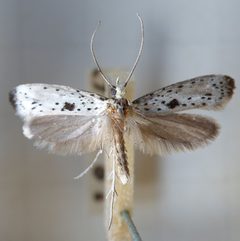
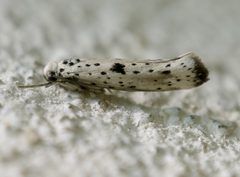
Yponomeuta plumbella is a small ermine moth ( Yponomeutidae) with a wingspan of 16–20 mm. are distinguished by white forewings marked with three rows of small black spots, a larger black splotch on the inner rim, and a black tip. The has a with larvae feeding gregariously within silken webs on European spindle (Euonymus europaeus). Native to Europe and Asia Minor, it has been introduced to the northeastern United States but has not established widespread .

Pronunciation
How to pronounce Yponomeuta plumbella: /jˌpɒnoʊˈmeʊtə plʌmˈbɛlə/
These audio files are automatically generated. While they are not always 100% accurate, they are a good starting point.
Identification
Distinguished from by the larger black splotch on the inner rim of the forewing and the black tip marking. Yponomeuta cagnagella and Y. irrorella share the same plant but differ in wing pattern details. Larval webs are smaller and less conspicuous than those of Y. cagnagella on the same host.
Images
Appearance
have white forewings with three rows of small black spots, a conspicuous larger black splotch on the middle of the inner rim, and a black marking at the wing tip. Hindwings are greyish. Legs and long are white. Wingspan measures 16–20 mm. First-instar larvae are straw-yellow with black lateral spots and yellow ; mature caterpillars reach 18–20 mm in length.
Habitat
Inhabits fields, parks, and woodland areas where European spindle (Euonymus europaeus) occurs. In England, associated with chalk-rich areas. Collection records include Wytham Woods, Oxfordshire and Hartslock Nature Reserve.
Distribution
Native to most of Europe, extending to Asia Minor. Present in northern, central and eastern Europe, southern Scandinavia, southwest Ireland, and central/southern England and Wales. Introduced to the United States (Massachusetts and Rhode Island), first recorded from Martha's Vineyard in 1949; not spreading from probable introduction sites.
Seasonality
: larvae predominantly present April to June, active July and August. Some sources suggest partial second in some regions, though study confirms univoltine cycle.
Diet
Larvae feed exclusively on leaves of European spindle (Euonymus europaeus). Early instars burrow into fresh shoots before feeding on leaves within silken webs.
Host Associations
- Euonymus europaeus - obligate larval European spindle; larvae feed on leaves and shoots
Life Cycle
laid on twigs and branches in autumn. Larvae overwinter just below empty eggshells, resume development in spring. Five larval instars; caterpillars become gregarious and spin silken webs for protection. occurs within or near the web. emerge July–August.
Behavior
Larvae are gregarious, spinning collective silken webs on the food plant that contain relatively few individuals compared to . are and attracted to light. Females less attracted to light than males in related , though specific data for this species is limited.
Ecological Role
Herbivorous insect specialized on European spindle. Larval feeding and web-spinning may cause localized defoliation. Serves as research subject for studies on plant specificity and evolution in herbivorous insects.
Human Relevance
Minor ornamental pest on European spindle in parks and gardens. sequencing (636.6 Mb assembly) provides genomic resource for studying insect-plant . Introduced to North America but not considered .
Similar Taxa
- Yponomeuta cagnagellaShares plant Euonymus europaeus; distinguished by larger, more conspicuous larval webs and subtle differences in wing pattern
- Yponomeuta irrorellaAlso feeds on Euonymus europaeus; differs in forewing spot pattern and lacks the prominent inner rim splotch
More Details
Genomic resources
Chromosomal-level assembly available: 636.6 Mb with 31 pseudomolecules (29 + Z ) and 16.5 kb mitochondrial genome. Facilitates research into evolution of plant specificity.
Introduced range status
Established in Massachusetts and Rhode Island since 1949 but remains localized; has not expanded from probable introduction sites despite >70 years of presence.
Sources and further reading
- BugGuide
- Wikipedia
- GBIF taxonomy match
- iNaturalist taxon
- Catalogue of Life
- Disholcaspis-plumbella - Entomology Today
- The Insects Behind the Weird Growths on Plants
- Urban Moths Have Evolved to Avoid the Big City Lights
- The genome sequence of the Black-tipped Ermine, Yponomeuta plumbella (Denis & Schiffermüller, 1775).