
Oeneis melissa
(Fabricius, 1775)
Melissa Arctic
Species Guides
1Oeneis melissa, the Melissa Arctic, is a Holarctic in the Nymphalidae. It inhabits cold, high-elevation and high-latitude environments including arctic tundra and alpine zones. The species exhibits a or partially biennial adapted to short growing seasons. Multiple have been described across its range, including the O. m. semidea in the White Mountains of New Hampshire.
Pronunciation
How to pronounce Oeneis melissa: //ɔɪˈniːɪs məˈlɪsə//
These audio files are automatically generated. While they are not always 100% accurate, they are a good starting point.
Identification
Distinguished from other Oeneis by combination of size, wing pattern, and . Oeneis chryxus (Chryxus Arctic) has more extensive orange on upper wings and different habitat preferences. Oeneis nevadensis (Nevada Arctic) occurs in western North America with different submarginal banding. Oeneis polixenes (Polixenes Arctic) has reduced eyespot development. O. m. semidea is restricted to the White Mountains of New Hampshire and can be distinguished by geographic isolation from other subspecies.
Images
Appearance
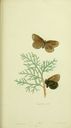
Wingspan 42–51 mm. Upper wing surfaces brown with orange-brown to ochre patches and dark eyespots; undersides mottled gray-brown providing cryptic camouflage against rocky substrates. clubbed with pale tips. Body densely hairy, adapted for cold environments. Sexes similar, with males typically slightly smaller.
Habitat
Arctic and alpine tundra, talus slopes, rocky summits and saddles, frost-heaved clear cuts, and windswept mountain peaks above treeline. Occupies cold, exposed environments with low vegetation cover and rocky substrates. In New Hampshire, restricted to high-elevation alpine zones of the White Mountains.
Distribution
Holarctic distribution: Siberia; North American Arctic from Alaska east to Baffin Island and Labrador; isolated in Rocky Mountains south to northern New Mexico; White Mountains of New Hampshire. distributed across specific regions: O. m. melissa (Newfoundland, Labrador), O. m. also (Polar Urals, Arctic Asia, Taymur, Chukot Peninsula, Kamchatka, Wrangel Island), O. m. orientalis (eastern Yakutia, Magadan), O. m. daizetsuzana (Japan), O. m. semidea (New Hampshire), O. m. semplei (Quebec, inner Labrador, Hudson Bay), O. m. assimilis (Northwest Territories), O. m. gibsoni (Alaska, Yukon, northern British Columbia), O. m. beanii (Alberta, British Columbia, Washington, Montana, Wyoming), O. m. lucilla (range not specified in sources), O. m. karae (polar tundra of northern Siberia).
Seasonality
active mid-June to early July in alpine ; timing varies by latitude and elevation across range. period corresponds to brief snow-free growing season in arctic and alpine .
Diet
feed on nectar from available flowers in , including alpine flowering plants. Larvae feed on sedges (Carex spp.), specifically documented on Carex bigelowii and Carex rupestris.
Host Associations
- Carex bigelowii - larval food plant
- Carex rupestris - larval food plant
Life Cycle
or partially biennial. laid in late summer on or near plants. Larvae overwinter and develop through two growing seasons, feeding on sedges. occurs in late spring to early summer of second year. in mid-June to early July. Extended larval development represents to short growing seasons at high elevations and latitudes.
Behavior
Males exhibit , patrolling rocky summits to locate females. Territorial perching on prominent rocks observed. Strong site fidelity with limited between mountain peaks. Basking on rocks for in cold environments. Reduced activity during cloudy or windy conditions. Mating occurs shortly after female ; protandry may produce female-biased operational sex ratio.
Ecological Role
of alpine and arctic flowering plants. Herbivore in tundra and alpine grassland . Prey for alpine birds and . Contributes to nutrient cycling through larval feeding and activities.
Human Relevance
Subject of ecological research on alpine demography and climate change impacts. O. m. semidea studied for in the White Mountains. for alpine health and climate warming effects.
Similar Taxa
- Oeneis chryxusSimilar size and wing pattern; distinguished by more extensive orange on upper wings and different preferences in western North America
- Oeneis nevadensisOverlaps in western North America; distinguished by different submarginal banding pattern and more western distribution
- Oeneis polixenesSimilar arctic-alpine ; distinguished by reduced eyespot development on wings
More Details
Conservation status
O. m. semidea to White Mountains of New Hampshire; vulnerable to loss from climate change and potential extinction from catastrophic events such as wildfires. 2020 California wildfires destroyed habitats of related O. nevadensis at southern range limits, demonstrating vulnerability of alpine Oeneis .
Research history
Long-term demographic studies conducted on O. m. semidea using mark-recapture methods; research documents , timing, and behavioral in alpine environments.
Sources and further reading
- BugGuide
- Wikipedia
- GBIF taxonomy match
- iNaturalist taxon
- NCBI Taxonomy
- Catalogue of Life
- Matt Forister: Melissa Blue Butterfly and Colonization of Alfalfa | Bug Squad
- Attracting Pollinators to Your Garden | Bug Squad
- Rising from the Ashes--Some Day | Bug Squad
- How One Entomologist Brings a Passion for Science Back to Her Home Country
- How a Colorado Extension Entomologist Wrangles Pests and Protects Biodiversity
- From the Lab to the Legislature and Living Room: Science Needs Storytellers
- Notes on the Demography, Life History, and Behavior of the White Mountain Arctic Butterfly (Oeneis melissa semidea)