
Boloria selene
(Denis & Schiffermüller, 1775)
Small Pearl-bordered Fritillary, Eurasian Silver-bordered Fritillary, Silver-bordered Fritillary
Boloria selene is a medium-sized fritillary with a trans-Eurasian and North American distribution. The exhibits complex including with distinct behavioral and developmental differences between spring and summer . In Europe it is known as the small pearl-bordered fritillary; in North America it is called the silver-bordered fritillary. The species serves as a grassland indicator and has been extensively studied in the context of conservation management including prescribed fire and grazing regimes.
Pronunciation
How to pronounce Boloria selene: /bɔˈlɔː.rɪ.a ˈsɛ.lɛ.neɪ/
These audio files are automatically generated. While they are not always 100% accurate, they are a good starting point.
Identification
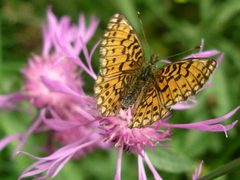
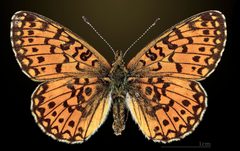
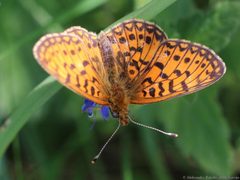
Distinguished from other Boloria by the silver-colored chevron markings on the hindwing underside, which form a continuous marginal band. The upperside is orange-brown with black markings and a row of pearl-like spots on the hindwing margin. Smaller than the pearl-bordered fritillary (Boloria euphrosyne), with more rounded wing margins. The silver-bordered fritillary name refers to the distinctive silvery markings on the wing borders, which are more prominent than in related species.
Images
Habitat
Wet grassland including meadows, marshes, and damp woodland clearings. In the Great Plains of North America, occurs in cattle-grazing grasslands and responds positively to patch-burn grazing management. In Europe, found in flower-rich grasslands along river corridors and in upland areas. Requires presence of larval food plants (violets) in moist, grassy environments.
Distribution
Trans-Eurasian and North American distribution. Present across Europe including the United Kingdom, extending through European Russia and northern Asia. In North America, occurs in the northern Great Plains and adjacent regions. Documented in North Dakota grasslands and in conservation sites along the River Tweed in Scotland.
Seasonality
with two distinct periods per year. First active in spring (emerging from overwintered larvae); second generation active in summer. In North Dakota, flight season occurs from June through mid-August. Protandry (earlier male ) observed in first generation but absent in second generation. Overwinters in larval stage.
Diet
Larvae feed exclusively on violets (Viola spp.). nectar on diverse floral resources including thistles (Cirsium spp.); nectaring plant choice is more specialized in first and more opportunistic in second generation.
Host Associations
- Viola - larval food plantexclusive larval ; required in moist grassland
Life Cycle
with two per year and different developmental . First generation: larvae develop directly without , producing summer . Second generation: larvae enter diapause to overwinter, resuming development in spring. Overwinters as larva. laid in late summer to early autumn for the generation.
Behavior
activity patterns differ between and sexes. Female flight activity decreases in second generation while male activity remains unchanged. Resting proportion increases in second generation for both sexes. Females exhibit higher flight distances than males and greater propensity for long-distance , particularly in second generation. First generation characterized by local growth and ; second generation adapted for dispersal and of new .
Ecological Role
Serves as an for grassland health due to complex requirements throughout . Contributes to pollination services in grassland ecosystems. Acts as a model organism for studying effects of land management practices including prescribed fire and grazing regimes on .
Human Relevance
Subject of conservation research examining patch-burn grazing and prescribed fire management in North American grasslands. Used as an in restoration projects including Along the Tweed initiative in Scotland. Featured in citizen science monitoring programs and conservation education. respond positively to management that maintains habitat heterogeneity and controls woody encroachment.
Similar Taxa
- Boloria euphrosyneLarger size with more angular wing margins; pearl spots on hindwing less continuous than silver chevrons of B. selene
- Boloria bellonaNorth American meadow fritillary with similar preferences but distinct wing pattern lacking continuous silver marginal band
Sources and further reading
- BugGuide
- GBIF taxonomy match
- iNaturalist taxon
- NCBI Taxonomy
- Catalogue of Life
- Funding from ScottishPower Foundation helps to restore vital habitat to encourage thriving natural ecosystem - Buglife Blog - Buglife
- Do Managed Burns in Grasslands Benefit Butterflies?
- An Evening at Silent Valley - Buglife Blog - Buglife
- Figure 3: Behaviour [%] observed during the first capture event of Boloria selene for males (left) and females (right) in the first (A) and second (B) generation.