
Boloria bellona
(Fabricius, 1775)
Meadow Fritillary
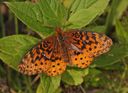
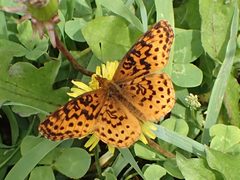
Boloria bellona, commonly known as the meadow fritillary, is a North American in the brushfoot Nymphalidae. It is distinguished from other fritillaries by its lack of silver spots on the wing underside and its squared-off forewing apex. The inhabits wet, open grasslands and has been observed using violets (Viola spp.) as plants for its larvae. It produces one or two annually and overwinters in the larval stage.
Pronunciation
How to pronounce Boloria bellona: /bɔˈloʊɹiə bəˈloʊnə/
These audio files are automatically generated. While they are not always 100% accurate, they are a good starting point.
Identification
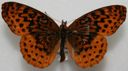
Distinguished from similar Boloria by: squared-off forewing apex (vs. rounder in B. selene); absence of silver spots on hindwing underside (present in B. selene); larger size than B. eunomia and B. chariclea; non-hairy wing bases (vs. hairy in B. eunomia); and hindwing underside coloration—mottled orange and purplish-brown with yellowish band (vs. rust-red, yellow, and white bands in B. eunomia; deep rusty red in B. chariclea).
Images
Appearance
Wingspan 3.5–5.1 cm. Upperside yellow-orange with dark spots, lines, and zigzagged bands. Forewing squared off just below apex. Hindwing lacks dark marginal border on most individuals. Underside mottled orange and purplish-brown with yellowish band across hindwing center. Forewing underside smudged with orange and brown near apex. Lacks silver spots characteristic of most lesser fritillaries. Long palps present.
Habitat
Wet, open environments including pastures, fields, and streamsides. Associated with grassland maintained by disturbance regimes.
Distribution
North America. Specific range boundaries not detailed in available sources.
Seasonality
period June through mid-August in North Dakota; timing varies by latitude. One or two per year.
Diet
Larvae feed on Viola pallens (northern white violet) and Viola sororia (common blue violet). nectar sources not specified in available sources.
Host Associations
- Viola pallens - plantnorthern white violet
- Viola sororia - plantcommon blue violet
Life Cycle
greenish-yellow, deposited near plants on twigs or leaves. Mature larvae gray and black with small, light-colored spines. Chrysalis yellow-brown. Overwinters as larva. One or two annually. Female is active partner during mating.
Behavior
Female initiates mating by active . laid near plants rather than directly on foliage.
Ecological Role
. for grassland health in managed landscapes. Larval herbivore on Viola .
Human Relevance
Subject of conservation research in managed grasslands, particularly regarding effects of prescribed fire and grazing regimes on persistence. shared with European Melitaea parthenoides, potentially causing confusion.
Similar Taxa
- Boloria seleneSimilar range and ; distinguished by rounder wings, dark hindwing margin border, and silver spots on hindwing underside
- Boloria eunomiaSimilar range; distinguished by smaller size, hairy wing bases, and rust-red, yellow, and white banding on hindwing underside
- Boloria charicleaSimilar range; distinguished by smaller size and deep rusty red hindwing underside
Misconceptions
The 'meadow fritillary' is also applied to the European Melitaea parthenoides, which is not closely related to B. bellona. This shared name may cause identification confusion.
More Details
Taxonomic note
Some sources list this under Clossiana (as Clossiana toddi), reflecting historical taxonomic treatments. Currently accepted placement is in Boloria.
Conservation research
Studies in North Dakota indicate higher , including grassland obligate , in patch-burn grazing systems compared to season-long grazing without fire. This suggests B. bellona may benefit from heterogeneity created by managed disturbance regimes.
Sources and further reading
- BugGuide
- Wikipedia
- GBIF taxonomy match
- iNaturalist taxon
- NCBI Taxonomy
- Catalogue of Life
- Funding from ScottishPower Foundation helps to restore vital habitat to encourage thriving natural ecosystem - Buglife Blog - Buglife
- Do Managed Burns in Grasslands Benefit Butterflies?
- An Evening at Silent Valley - Buglife Blog - Buglife