
Boloria chariclea
(Schneider, 1794)
Arctic fritillary, purplish fritillary
Species Guides
7- Boloria chariclea boisduvalii
- Boloria chariclea butleri(Butler's Fritillary)
- Boloria chariclea grandis(Purple Lesser Fritillary)
- Boloria chariclea helena
- Boloria chariclea ingens
- Boloria chariclea montinus(White Mountain Fritillary)
- Boloria chariclea rainieri(Tacoma Fritillary)
Boloria chariclea is a Holarctic in the Nymphalidae, known as the Arctic fritillary or purplish fritillary. It inhabits cold northern environments including tundra, taiga, alpine meadows, and acid bogs. The exhibits a two-year in some , with larvae hibernating during first and second winters. Multiple are recognized across its broad range, including the B. c. montinus isolated in the White Mountains of New Hampshire for approximately 9,000 years.
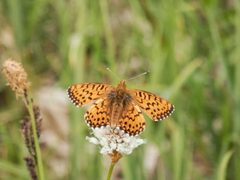
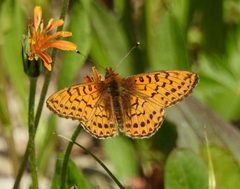
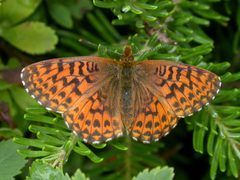
Pronunciation
How to pronounce Boloria chariclea: /boʊˈlɔːriə ˌkærɪˈkliːə/
These audio files are automatically generated. While they are not always 100% accurate, they are a good starting point.
Images
Habitat
Tundra, taiga, alpine meadows, stream verges, and acid bogs. In the White Mountains of New Hampshire, the B. c. montinus occurs in the alpine zone at elevations between 1250 m and 1850 m, with highest densities in herbaceous-snowbank plant and broader distribution in heath-shrub-rush communities; cushion-tussock is used sparingly.
Distribution
Holarctic. Palearctic: northern Lapland, Russia, Arctic Europe, Arctic Asia, Wrangel Island, Chukotka, Kamchatka. Nearctic: Alaska, much of Canada, north Cascades (Washington), Rocky Mountains south to Utah and northern New Mexico, northern Minnesota, northern Maine, White Mountains of New Hampshire.
Seasonality
fly from July to August depending on location. period in the White Mountains occurs in July.
Diet
Larvae feed on Viola (including V. biflora in Europe), dwarf willows (Salix), and possibly Vaccinium in North America; also believed to feed on Cassiope tetragona in Europe. nectar on flowers; abundance positively associated with number of inflorescences within survey area.
Host Associations
- Viola biflora - larval food plantEurope
- Cassiope tetragona - larval food plantEurope; believed
- Salix - larval food plantdwarf willows; North America
- Vaccinium - larval food plantpossibly; North America
Life Cycle
laid singly underneath leaves of plant. Larval development takes one or two years depending on location. Newly hatched caterpillars hibernate during the first winter; fourth-stage caterpillars hibernate during the second winter in two-year .
Behavior
Males patrol along edges of bogs and in valleys to locate females. Easily alarmed by human approach. Detectability affected by weather conditions including wind speed and maximum daily temperature, as well as observer identity.
Ecological Role
; abundance positively associated with floral resources.
Similar Taxa
- Boloria seleneBoth are fritillaries in the Boloria with overlapping Holarctic distributions; B. selene (small pearl-bordered fritillary) occurs in more southern and has different wing pattern elements.
- Boloria euphrosyneSimilar fritillary ; B. euphrosyne (pearl-bordered fritillary) has distinct wing markings and more southern distribution in Europe.
More Details
Subspecies
Eight recognized: B. c. chariclea (Arctic Europe), B. c. arctica (Arctic Asia, Wrangel Island, Chukotka), B. c. butleri (Arctic America, Chukotka, Kamchatka), B. c. boisduvalii (Alaska, Alberta, Labrador, Newfoundland, Minnesota, British Columbia), B. c. rainieri (Washington), B. c. grandis (North British Columbia, Ontario), B. c. montina (White Mountains, New Hampshire— glacial relict), B. c. helena (Rocky Mountains).
Conservation note
B. c. montinus is a rare restricted to approximately 1130 ha of alpine in the Presidential Range, isolated from northern for approximately 9,000 years. Point count surveys have proven effective for monitoring this in its fragmented alpine environment.
Sources and further reading
- BugGuide
- Wikipedia
- GBIF taxonomy match
- iNaturalist taxon
- NCBI Taxonomy
- Funding from ScottishPower Foundation helps to restore vital habitat to encourage thriving natural ecosystem - Buglife Blog - Buglife
- Do Managed Burns in Grasslands Benefit Butterflies?
- An Evening at Silent Valley - Buglife Blog - Buglife
- Density and Habitat Relationships of the Endemic White Mountain Fritillary (Boloria chariclea montinus) (Lepidoptera: Nymphalidae)