
Boloria eunomia
(Esper, 1799)
Bog Fritillary, Ocellate Bog Fritillary
Boloria eunomia is a circumboreal fritillary distributed across the Holarctic in tundra, forest-tundra, and open acid bog . are orange-brown with distinctive round silver spots on the hindwing underside, a key diagnostic feature. The exhibits ecotypic variation: meadow feed primarily on Polygonum bistorta, while bog populations utilize Ericaceae including Vaccinium species. It is with adults flying from late May through July depending on latitude. The species is considered vulnerable in parts of its range due to habitat loss from drainage, recreational development, and climate change.
Pronunciation
How to pronounce Boloria eunomia: /bɔˈlɔɹiə juˈnɔmiə/
These audio files are automatically generated. While they are not always 100% accurate, they are a good starting point.
Identification
Distinguished from similar Boloria by the hindwing underside pattern: B. eunomia is the only species with a complete row of silvery submarginal spots. B. selene (Small Pearl-bordered Fritillary) lacks this feature, showing instead a more irregular pattern of silver markings. B. euphrosyne (Pearl-bordered Fritillary) has more extensive pearl markings on the hindwing underside. Examination of the hindwing underside is essential for reliable field identification.
Images
Appearance
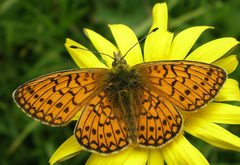
Forewing length 20–24 mm. Wings orange-brown above with dark markings and narrow black marginal band containing small submarginal lunules. Hindwing underside orangish-brown with tan postmedian band followed by a diagnostic row of round silver-centered ocelli. Basal area separated from central area by black dentate line. Hindwing proximally dull ochreous with yellowish macular bands near base and middle. area of hindwing beneath light yellow with thin hastate markings before margin.
Habitat
Open acid bogs, fens, wet meadows, moist tundra, and willow seeps. In montane regions, damp subalpine and alpine meadows with Polygonum bistorta at 2250–2500 m elevation. Extremely stenotopic, limited by presence of specific plant associations. Requires moist conditions with standing water or high water table.
Distribution
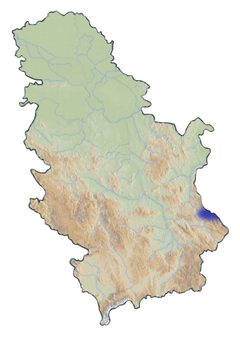
Circumboreal Holarctic distribution: Europe (Scandinavia, Baltic states, Poland, Romania, Bulgaria, Serbia, Caucasus), Asia (Armenia, Turkey, Russia), and North America (Newfoundland to Alaska, south to Colorado and Wyoming). include triclaris (Newfoundland to Alberta), nichollae (Alberta), and denali (Alaska and northern Yukon).
Seasonality
. period: late May to early August in lowland , mid-June to July in montane populations (peak mid-June in Armenia, late July in North Caucasus).
Diet
feed on nectar from flowers including Labrador tea (Rhododendron groenlandicum), goldenrod (Solidago spp.), and Polygonum bistorta. Larvae feed on Polygonum bistorta (meadow ), Vaccinium uliginosum, Vaccinium oxycoccus, and other Ericaceae (bog ecotype).
Host Associations
- Polygonum bistorta - larval plantPrimary for meadow ; also accepted by bog ecotype though absent from bog
- Vaccinium uliginosum - larval plantEricaceae for bog ; experimental studies show lowest larval mortality on this
- Vaccinium oxycoccus - larval plantField-observed main for bog despite poorer experimental survival
- Rhododendron groenlandicum - nectar sourceLabrador tea
Life Cycle
. laid in groups of 2–4 under plant leaves, hatching in 7–8 days. Larvae feed on underside of host leaves; third or fourth instars hibernate. Larval period: April–June in North American . occurs in vegetation. emerge and fly June–July (montane) or May–August (lowland). No evidence of partial second .
Behavior
Males search for females in wet areas and exhibit polygynous mating system with non-discriminatory courtship toward all encountered females. Females display mate-refusal posture or flee to reject unwanted males. patterns are -dependent: female-biased occurs at high male densities due to harassment, while male emigration occurs at low female densities. fly close to ground and activity is significantly influenced by wind direction and weather conditions.
Ecological Role
of bog and wet meadow flora. Serves as for intact bog hydrology and acid wetland . Associated with other including Lycaena helle in optimal .
Human Relevance
Subject to conservation concern; listed as vulnerable in parts of European range due to bog drainage, fragmentation, and recreational development. Used as in grassland and wetland management studies, including patch-burn grazing research in North American Great Plains.
Similar Taxa
- Boloria seleneSmall Pearl-bordered Fritillary lacks the complete row of silvery submarginal ocelli on hindwing underside that distinguishes B. eunomia; shows more irregular silver spotting pattern
- Boloria euphrosynePearl-bordered Fritillary has more extensive and irregular pearl markings on hindwing underside, not arranged in distinct submarginal row
More Details
Ecotypic Variation
show genetically based ecotypic divergence between meadow and bog , with meadow exhibiting obligate specialization on Polygonum bistorta and bog ecotype showing broader but less efficient use of Ericaceae. This asymmetry suggests meadow habitats are ancestral with subsequent to bogs.
Conservation Status
Threatened by bog hydrology alterations including drainage, peat extraction, and recreational development. Armenian occupies less than 100 m² and high elimination risk. Romanian populations are peripheral with unique haplotypes, indicating long-term isolation.
Sources and further reading
- BugGuide
- Wikipedia
- GBIF taxonomy match
- iNaturalist taxon
- NCBI Taxonomy
- Funding from ScottishPower Foundation helps to restore vital habitat to encourage thriving natural ecosystem - Buglife Blog - Buglife
- Do Managed Burns in Grasslands Benefit Butterflies?
- An Evening at Silent Valley - Buglife Blog - Buglife
- Asymmetry in host plant preferences of two ecotypes of Boloria eunomia (Lepidoptera: Nymphalidae)
- Boloria eunomia (Esper, 1799) (Lepidoptera: Nymphalidae) revised in the Caucasus: taxonomy, life history, rediscovery and conservation in Armenia
- First records of the bog fritillary Boloria eunomia (Esper, 1800) in the Romanian fauna (Lepidoptera, Nymphalidae): Peripheral populations in habitats of conservation concern