
Ancyloxypha numitor
(Fabricius, 1793)
Least Skipper
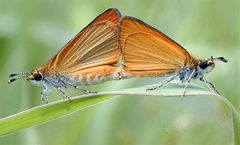
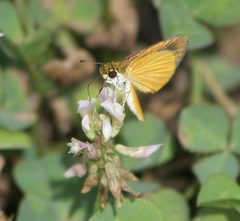
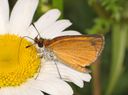
Ancyloxypha numitor, commonly known as the least skipper, is a small North American in the Hesperiidae. It is distinguished by rounded wings, a slender body, and checkered lacking hooks. The exhibits weak, fluttering reminiscent of Satyrinae butterflies. It completes multiple annually and overwinters as a larva.
Pronunciation
How to pronounce Ancyloxypha numitor: //ˌæŋkɪˈlɒksɪfə ˈnjuːmɪtɔːr//
These audio files are automatically generated. While they are not always 100% accurate, they are a good starting point.
Identification
Distinguished from similar skippers by rounded wings (not pointed), checkered , and complete dark band surrounding orange on upper hindwing. European Skipper (Thymelicus lineola) has pointed wings, short non-checkered antennae, and thin black wing margins. Tropical Least Skipper (Ancyloxypha arene) has more orange above and small black marginal spots below. Orange Skipperling (Copaeodes aurantiaca) is mostly bright orange above with black basal areas. Southern Skipperling (Copaeodes minima) is smaller with white ray on underside of hindwing.
Images
Habitat
Damp or wet with tall grasses. Associated with marshy areas, wet meadows, and grasslands with standing water or high soil moisture.
Distribution
North America. Present across much of the United States and southern Canada. Records from Alberta (irregular), Manitoba, and Saskatchewan in Canada. Range extends south to Florida, where it may be present year-round.
Seasonality
active May–September in northern range, February–December in southern range, and year-round in southern Florida. Two to four per year.
Diet
Larvae feed on various grasses including Cogongrass (Imperata sp.), Rice cutgrass (Leersia oryzoides), Cultivated rice (Oryza sativa), Panicum sp., Bluegrass (Poa sp.), Setaria sp., Cordgrass (Spartina sp.), and Marsh millet (Zizaniopsis miliacea). diet not specified in sources.
Host Associations
- Imperata sp. - larval Cogongrass
- Leersia oryzoides - larval Rice cutgrass
- Oryza sativa - larval Cultivated rice
- Panicum sp. - larval
- Poa sp. - larval Bluegrass
- Setaria sp. - larval
- Spartina sp. - larval Cordgrass
- Zizaniopsis miliacea - larval Marsh millet
Life Cycle
: Pale yellow, developing orange-red ring around middle. Laid singly on plant. Larva: Grass green with four white pairs of distinct wax glands along subventral . brown or tan, darker centrally. Collar with white and black stripes. Constructs nest by rolling single grass blade or tying multiple leaves with silk. Overwinters as larva in third or fourth instar. Pupa: Cream with brownish markings. Two to four annually.
Behavior
Males patrol through grass stands to locate females. Weak, fluttering described as Satyrinae-like. Larvae construct shelters by rolling or tying grass blades.
Ecological Role
Larval herbivore on grasses. Role in otherwise not documented in sources.
Human Relevance
Utilizes cultivated rice (Oryza sativa) as larval , indicating potential agricultural association. No other documented human interactions in sources.
Similar Taxa
- Thymelicus lineolaEuropean Skipper has pointed wings, short non-checkered , mostly orange upper wings with thin black margins, and male stigmata
- Ancyloxypha areneTropical Least Skipper has more orange on upper wings and very small black marginal spots on underside
- Copaeodes aurantiacaOrange Skipperling is mostly bright orange above with black basal areas, and males have black stigmata
- Copaeodes minimaSouthern Skipperling is smaller and has white ray across underside of hindwing