
Hesperia
Fabricius, 1793
Branded Skippers
Species Guides
19- Hesperia assiniboia(Plains Branded Skipper)
- Hesperia attalus(Dotted Skipper)
- Hesperia balcones
- Hesperia colorado(American Branded Skipper)
- Hesperia columbia(Columbian skipper)
- Hesperia comma(silver-spotted skipper)
- Hesperia dacotae(Dakota skipper)
- Hesperia juba(Juba skipper)
- Hesperia leonardus(Leonard's skipper)
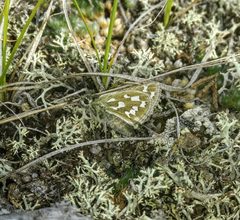
Hesperia is a Holarctic of skippers (Hesperiidae) commonly known as the branded skippers. Most are to North America, with Hesperia comma widespread across the Holarctic, H. florinda restricted to temperate eastern Asia, and H. nabokovi endemic to Hispaniola. The genus contains approximately 25 species characterized by distinctive wing markings and rapid, darting patterns typical of skippers.
Pronunciation
How to pronounce Hesperia: /hɛˈspiː.ri.ə/
These audio files are automatically generated. While they are not always 100% accurate, they are a good starting point.
Identification
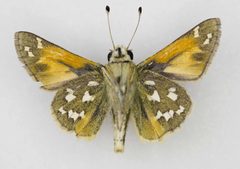
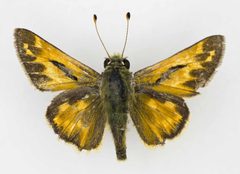
Distinguished from other Hesperiidae by the combination of widely separated antennal bases, hooked antennal clubs, and the characteristic dark forewing bands. Similar genera such as Ochlodes and Polites can be separated by wing pattern details, particularly the arrangement of pale spots and the shape of the dark branding. -level identification requires examination of genitalia and detailed wing pattern analysis, often involving the number and arrangement of pale spots on the hindwing underside.
Images
Appearance
Medium-sized skippers with robust bodies and relatively large . are widely separated at the base, with hooked or curved clubs. Wings are typically orange-brown to tawny with dark brown or black markings, including characteristic dark bands or "brands" on the forewings that give the group its . Hindwings often show pale spots or checkered margins. Wing shape is somewhat angular with forewings longer than hindwings.
Habitat
Open including grasslands, prairies, meadows, and alpine slopes. Most favor dry, sunny areas with sparse vegetation. Some species occupy specialized habitats such as chalk grasslands, coastal dunes, or montane meadows. Thermophilous species requiring warm microclimates.
Distribution
Holarctic distribution with centers of diversity in North America and the Palearctic. Most to North America. Hesperia comma occurs throughout Europe, Asia, and North America. Hesperia florinda is restricted to temperate eastern Asia. Hesperia nabokovi is endemic to Hispaniola. GBIF records indicate presence in Denmark, Norway, Sweden, and the United States including Vermont.
Seasonality
periods vary by and latitude. Most North American species fly from late spring through summer (May-August). Hesperia comma has flight from July to September in Europe, peaking mid-August. Some , particularly at high latitudes or elevations, may require two seasons to complete development.
Host Associations
- Festuca ovina - larval Hesperia comma
- Festuca liviensis - larval Hesperia comma
Life Cycle
for most , with single per year. stage varies: or larvae depending on species and climate. Some high-latitude require two years to complete development. Larvae construct shelters by folding or tying grass blades.
Behavior
Males are highly territorial, perching on low vegetation to intercept females and chase rival males. Rapid, darting with quick wingbeats characteristic of skippers. visit flowers for nectar, with some showing strong fidelity to particular nectar sources. Relatively high capacity in some species, facilitating range expansion and of suitable patches.
Ecological Role
serve as when visiting flowers. Larvae function as primary consumers, feeding on grasses and contributing to nutrient cycling in grassland . Serve as prey for various including birds, spiders, and .
Human Relevance
Hesperia comma is a conservation focus in the UK, where it is rare and vulnerable but recovering due to targeted management. Some serve as indicators of healthy grassland . are observed by enthusiasts and contribute to citizen science monitoring programs.
Similar Taxa
- OchlodesSimilar size and coloration, but Ochlodes typically have more extensive pale spotting and lack the distinct dark forewing brands
- PolitesOverlapping preferences and period; Polites generally smaller with more checkered wing patterns and reduced branding
- AtalopedesSimilar orange-brown coloration; Atalopedes has more pointed forewings and different spot arrangement
More Details
Genome Sequencing
Hesperia comma sequenced at 525.3 Mb with 29 chromosomal pseudomolecules (27 plus Z and W ), 17.73 kb mitochondrial genome, and 18,725 protein-coding genes
Conservation Status
UK of Hesperia comma are rare and restricted to southern England, classified as vulnerable but showing recovery with appropriate management including grazing regimes that maintain short, sparse swards