
Hesperia comma
Linnaeus, 1758
silver-spotted skipper, common branded skipper, Holarctic grass skipper
Species Guides
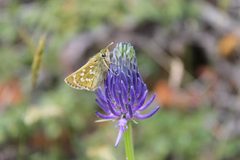
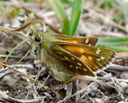
3Hesperia comma is a in the Hesperiidae with a Holarctic distribution spanning Europe, Asia, North Africa, and North America. The exhibits strong specificity for warm, open calcareous grasslands with sparse short vegetation. Males are highly territorial, and the species shows with males bearing a wide black sex brand on the forewing. In the United Kingdom, it was historically rare and restricted to chalk downlands of southern England but has experienced significant recovery through targeted conservation efforts.
Pronunciation
How to pronounce Hesperia comma: //hɛˈspɪriə ˈkɒmə//
These audio files are automatically generated. While they are not always 100% accurate, they are a good starting point.
Identification
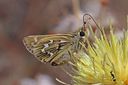
Distinguished from the similar large skipper (Ochlodes sylvanus) by: (1) numerous white spots on the underside of hindwings versus fewer or absent spots in O. sylvanus; (2) darker tips on the upper forewings; and (3) non-overlapping periods in Britain, where H. comma emerges in August after O. sylvanus has finished flying. The male sex brand on the forewing separates sexes.
Images
Appearance
Medium-sized skipper with orange-brown upperwings marked with dark checkering. The underside of the hindwings displays numerous distinct white spots, a key diagnostic feature. Forewing tips on the upperside tend to be darker. Males possess a wide black sex brand below the of the forewing, absent in females. The is often confused with the large skipper (Ochlodes sylvanus) but differs in wing pattern and .
Habitat
Warm, open calcareous grasslands with sparse, short vegetation. In the UK, restricted to chalk downlands. Prefers sites with short turf (up to 4 cm), often adjacent to patches of bare ground. Thermophilous, requiring warm microclimates.
Distribution
Holarctic distribution: throughout most of Europe, Asia to China and Japan, North Africa, and North America with multiple . In the United Kingdom, rare and historically restricted to southern England chalk downlands; range has expanded due to conservation success. Subspecies in North America include H. c. borealis, H. c. hulbirti, H. c. laurentina, and H. c. manitoba among others.
Seasonality
with period from July to September, peaking in mid-August. In Britain, active primarily in August when sympatric skippers have finished flying. In Alaska, requires two seasons to complete development.
Host Associations
- Festuca ovina - primary larval foodplantfemales lay on leaf blades; larvae construct tent-like feeding shelters from leaf blades and silk
- Festuca liviensis - secondary larval foodplant
Life Cycle
Females lay single during August and September on leaf blades of the primary foodplant, preferentially on small tufts no more than 5 cm tall adjacent to bare ground and not recently grazed. Eggs overwinter and hatch in March. Larvae feed within constructed tent-like shelters of leaf blades and silk for 14–15 weeks before pupating at the base of the foodplant. lasts 10–14 days. Males typically emerge before females.
Behavior
Males are highly territorial, perching on prominent objects and flying to intercept females or evict rival males. The exhibits relatively high capacity. are fast, darting fliers characteristic of skippers.
Human Relevance
Subject of significant conservation efforts in the United Kingdom, where increased approximately 1500% over twenty years through management including grazing regimes and rabbit population recovery. Climate change has also contributed to range expansion. Serves as an for calcareous grassland health.
Similar Taxa
- Ochlodes sylvanusSimilar size and general appearance, but distinguished by fewer white spots on hindwing underside, lighter forewing tips, and earlier period in Britain
- Epargyreus clarusShares the 'silver-spotted skipper' in North America, but is a spread-winged skipper in Eudaminae with different wing posture and pattern
More Details
Genomic resources
assembly available from female specimen from Szöc, Hungary: 525.3 Mb, 29 chromosomal pseudomolecules including Z and W , 18,725 protein-coding genes (Wellcome Open Research 2024)
Conservation status
Listed as Least Concern in Europe but Vulnerable in the United Kingdom; UK conservation success cited as model for targeted management
Sources and further reading
- BugGuide
- Wikipedia
- GBIF taxonomy match
- iNaturalist taxon
- NCBI Taxonomy
- Catalogue of Life
- Bees and CAMBP Prevail at California Honey Festival | Bug Squad
- Friday Editor’s Tip: Lose the formatting! | Beetles In The Bush
- Bug Eric: Emerald Valley, 2016
- Navy Entomologists: Protecting Sailors and Marines Around the World
- [No taxon] | Beetles In The Bush | Page 5
- Athlete to Professor: How One Entomologist Discovered His Interest in Bugs, Education, and Service
- The genome sequence of the Silver-spotted Skipper, Hesperia comma (Linnaeus, 1758).