
Ochlodes
Scudder, 1872
Species Guides
3- Ochlodes agricola(Rural Skipper)
- Ochlodes sylvanoides(Woodland Skipper)
- Ochlodes yuma(Yuma Skipper)
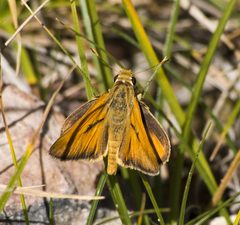
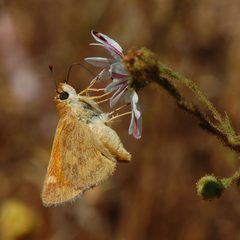
Ochlodes is a Holarctic of in the Hesperiidae, tribe Hesperiini. The genus contains approximately 25 distributed across North America, Europe, Asia, and parts of the Caribbean. Several species have been subject to taxonomic revision, with some forms debated as or synonyms. The woodland skipper (Ochlodes sylvanoides) and large skipper (Ochlodes sylvanus) are among the most frequently referenced species in ecological studies.
Pronunciation
How to pronounce Ochlodes: /ˈɒkləˌdiːz/
These audio files are automatically generated. While they are not always 100% accurate, they are a good starting point.
Identification
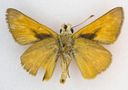
Members of Ochlodes can be distinguished from related skipper by genitalic characters and wing pattern details, though specific identification criteria vary by . The genus requires careful examination of male genitalia and wing venation for definitive determination. Some species pairs, such as Ochlodes venata and O. amurensis, remain taxonomically problematic and may represent single variable species.
Images
Habitat
vary by but generally include open woodlands, grasslands, forest edges, and riparian corridors. Ochlodes sylvanoides occurs in dry vegetation with blooming Euthamia, Hemizonia, and Epilobium. Ochlodes sylvanus inhabits woodland edges and clearings. Many species occupy montane or submontane zones in their Asian ranges.
Distribution
Holarctic distribution encompassing western North America (California to Oregon), Europe, northern Africa, and extensive Asian ranges including China, Japan, Taiwan, Korea, Mongolia, the Himalaya, and the Amur region. Disjunct occur in Haiti (O. batesi) and Mexico (O. samenta).
Seasonality
periods vary by latitude and . In California, Ochlodes sylvanoides has been recorded in late summer when Epilobium is in bloom. Ochlodes sylvanus flies from June to August in Europe. Multiple occur in warmer portions of the range.
Diet
Larvae feed on various grasses (Poaceae). nectar at diverse flowering plants including Epilobium (willowherbs/fireweeds), Euthamia (goldentops), and garden plants such as English lavender.
Host Associations
- Poaceae - larval foodplantgrasses
Life Cycle
Complete with , larva, pupa, and stages. Larvae are grass-feeders. occurs in silken shelters among plant stems or leaf litter.
Behavior
Rapid, darting characteristic of skippers. are strong fliers that patrol territories and nectar at flowers. Males perch to await females.
Ecological Role
serve as . Larvae function as primary consumers in grassland and woodland edge . declines have been documented in western North America, with Ochlodes agricola identified as declining in at least two independent datasets.
Human Relevance
Subject of long-term monitoring by researchers including Art Shapiro (UC Davis), who has tracked Ochlodes sylvanoides and related across California since 1972. Ochlodes agricola (rural skipper) was specifically identified as declining in a 2021 Science study on western North American trends. The serves as an indicator group for climate change impacts on insect populations.
Similar Taxa
More Details
Taxonomic Uncertainty
Several Ochlodes remain taxonomically unresolved. Ochlodes amurensis may represent a form of O. venata. Ochlodes formosana may be a of O. subhyalina. Gender agreement issues exist for O. niitakana (sometimes cited as O. niitakanus).
Population Trends
Research by Forister et al. (2021) documented a 1.6% reduction in numbers across the western United States from 1977-2018, with warming fall temperatures implicated. Ochlodes agricola was among 50 declining in at least two datasets. Ochlodes sylvanoides was specifically noted as absent from expected during 2014 monitoring in North Sacramento despite abundant nectar sources.
Research Importance
The has contributed significantly to understanding climate change impacts on insects. Art Shapiro's 50-year monitoring program in California, which includes multiple Ochlodes , represents one of the longest continuous datasets in North America and has demonstrated that declines extend beyond to entire faunas.