
Ochlodes yuma
(W.H. Edwards, 1873)
Yuma Skipper
Ochlodes yuma, commonly known as the Yuma skipper, is a grass ( Hesperiidae) to wetlands of western North America. The is notable for its specialized relationship with common reed (Phragmites australis), which serves as its sole known larval plant. Five have been described, reflecting geographic variation across its range. The species has been assigned MONA/Hodges number 4057.
Pronunciation
How to pronounce Ochlodes yuma: /ˈɒklədiːz ˈjuːmə/
These audio files are automatically generated. While they are not always 100% accurate, they are a good starting point.
Identification
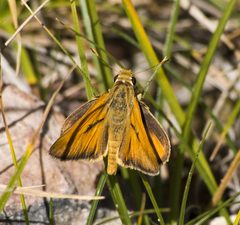
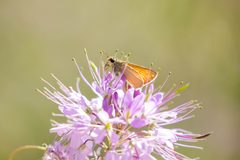
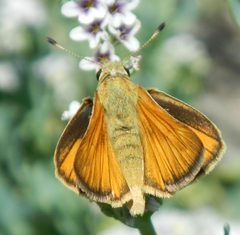
As a member of the Ochlodes, this can be distinguished from other grass skippers by its wetland association and geographic restriction to western North America. The five recognized (O. y. yuma, O. y. scudderi, O. y. anasazi, O. y. lutea, and O. y. sacramentorum) show regional variation in coloration and pattern; precise identification to subspecies level requires examination of genitalic characters and reference to original descriptions. Separation from the widespread and congeneric woodland skipper (Ochlodes sylvanoides) relies on habitat and geographic criteria, as O. sylvanoides occupies more mesic and upland environments.
Images
Habitat
Wetlands of western North America, specifically dominated by common reed (Phragmites australis).
Distribution
Western North America, with records from wetland localities across the region. show more restricted distributions: O. y. yuma (the nominate subspecies), O. y. scudderi, O. y. anasazi (Arizona/New Mexico region), O. y. lutea, and O. y. sacramentorum (California region).
Diet
Larvae feed exclusively on common reed (Phragmites australis). feeding habits have not been documented.
Host Associations
- Phragmites australis - larval sole known plant
Ecological Role
As a herbivore on Phragmites australis, the participates in wetland . Its restricted association suggests potential vulnerability to alteration affecting common reed stands.
Similar Taxa
- Ochlodes sylvanoidesCongeneric grass skipper with overlapping western North American range; distinguished by preference (upland/mesic vs. wetland) and lack of strict association with Phragmites australis
More Details
Taxonomic History
Originally described as Hesperia yuma by W.H. Edwards in 1873; later transferred to Ochlodes. GBIF currently lists the as a synonym of Ochlodes sylvanoides, though this treatment is not universally accepted and the two species are maintained as distinct by most North American lepidopterists.
Subspecies
Five recognized: O. y. yuma (Edwards, 1873) – nominate form; O. y. scudderi (Skinner, 1899); O. y. anasazi S. Cary & Stanford, 1995; O. y. lutea Austin in T. Emmel, 1998; and O. y. sacramentorum Austin in T. Emmel, 1998.
Conservation Context
The ' strict reliance on wetland and single plant may render it sensitive to wetland drainage, Phragmites management programs, and climate-driven changes in western North American wetland hydrology.
Sources and further reading
- BugGuide
- Wikipedia
- GBIF taxonomy match
- iNaturalist taxon
- NCBI Taxonomy
- 'Bee' One in a Million | Bug Squad
- A Close Call | Bug Squad
- 'Climate Change' May Be a Key Factor in Declining Butterfly Populations | Bug Squad
- Long-Distance Palm Weevil Flyers Threaten California Date Palms
- Bug Eric: SpiderIdentification.org
- Why are this beetle’s elytra outstretched? | Beetles In The Bush