
Poanes
Scudder, 1872
Species Guides
8- Poanes aaroni(Aaron's Skipper)
- Poanes hobomok(Hobomok Skipper)
- Poanes massasoit(mulberry wing)
- Poanes melane(umber skipper)
- Poanes taxiles(Taxiles Skipper)
- Poanes viator(Broad-winged Skipper)
- Poanes yehl(Yehl Skipper)
- Poanes zabulon(Zabulon Skipper)
Poanes is a of in the Hesperiidae, erected by Samuel Hubbard Scudder in 1872. The genus is distributed throughout North and Central America. In 2019, several were transferred to the new genus Lon, reducing Poanes to six recognized species. The genus is characterized by larvae that feed on grasses and sedges.
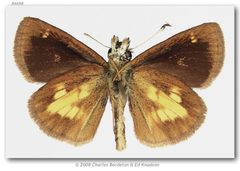
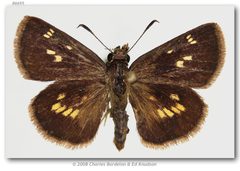
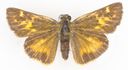
Pronunciation
How to pronounce Poanes: /ˈpoʊˌæniz/
These audio files are automatically generated. While they are not always 100% accurate, they are a good starting point.
Identification
in Poanes can be distinguished from the related Lon by taxonomic assignment following the 2019 revision; several former Poanes species including P. zabulon, P. hobomok, P. taxiles, and P. melane are now placed in Lon. Within the remaining Poanes, species are distinguished by wing pattern and distribution: P. aaroni (saffron skipper), P. benito (Benito's skipper), P. massasoit (mulberry wing), P. viator (broad-winged skipper), P. yehl (Yehl skipper), and P. zachaeus (Zachaeus skipper).
Images
Habitat
varies by . Poanes melane (now Lon melane) has been documented in riparian forest and urban lawn habitats, perching in dappled light and shade along streamsides, generally well off the ground. Its upper elevational limit at the latitude of I-80 in California is approximately 3000 feet.
Distribution
North America and Central America. Specific distribution records include Vermont, USA, and California (USA).
Seasonality
For Poanes melane (now Lon melane): two to three in central California, with season April–October; longer flight season in the San Francisco Bay Area. Earliest recorded in central California transect: March 26, 1988 (Gates Canyon, Vacaville).
Diet
Larvae feed on grasses and sedges. Poanes melane (now Lon melane) larvae feed on leaves of various grasses; in Berkeley, California, it has been observed breeding on Bermuda Grass (Cynodon dactylon). of Poanes melane visit flowers including Yerba Santa, dogbane, milkweed, thistles, yellow starthistle, California buckeye, and coyote brush.
Host Associations
- grasses - larval food plantgeneral for
- sedges - larval food plantgeneral for
- Cynodon dactylon - larval food plantBermuda Grass; observed for Poanes melane (now Lon melane) in urban Berkeley, California
Behavior
Poanes melane (now Lon melane) perches in dappled light and shade along streamsides, generally well off the ground.
Similar Taxa
- LonSeveral formerly placed in Poanes (P. zabulon, P. hobomok, P. taxiles, P. melane, P. inimica, P. azin, P. macneilli, P. ulphila, P. monticola, P. niveolimbus) were transferred to this new in 2019 based on phylogenetic revision.
More Details
Taxonomic revision
In 2019, a significant revision split Poanes, transferring ten to the newly erected Lon. The remaining six species in Poanes are: P. aaroni, P. benito, P. massasoit, P. viator, P. yehl, and P. zachaeus.