
Poanes massasoit
(Scudder, 1863)
mulberry wing
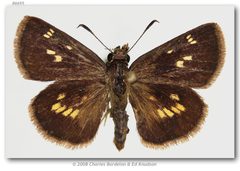
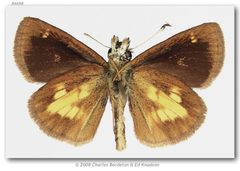
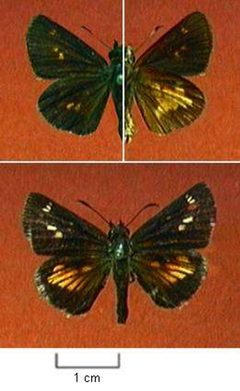
Poanes massasoit, commonly known as the mulberry wing, is a small native to eastern North America. have a wingspan of 22–29 mm and are characterized by their distinctive wing patterning. The is associated with wetland where its larval plants, primarily sedges in the Carex, grow. It has been documented from the East Coast of the United States through the Great Lakes region and into southern Canada.
Pronunciation
How to pronounce Poanes massasoit: /ˈpoʊˌæniz ˈmæsəˌsɔɪt/
These audio files are automatically generated. While they are not always 100% accurate, they are a good starting point.
Identification
The mulberry wing can be distinguished from similar Poanes by its relatively small size (wingspan 22–29 mm) and wing pattern. Specific diagnostic characters for field identification are not well documented in available sources. It may be confused with other small wetland-associated skippers in the Poanes, particularly where ranges overlap.
Images
Habitat
Wetland including areas where tussock sedge (Carex stricta) and other sedges occur. Associated with marshy areas and wet meadows where larval plants are present.
Distribution
East Coast of the United States; states south and southwest of the Great Lakes; southern Ontario and Quebec, Canada.
Diet
Larvae feed on tussock sedge (Carex stricta) and possibly Carex aquatilis. Other reported plants include Poaceae and Cyperaceae , though these associations are less certain. food sources are not documented in available sources.
Host Associations
- Carex stricta - larval primary plant
- Carex aquatilis - possible larval tentative association
- Poaceae - possible larval -level association, specific not confirmed
- Cyperaceae - possible larval -level association, specific not confirmed
Similar Taxa
- Poanes melaneBoth are small Poanes skippers with wetland associations; P. melane is found in western North America and is known as the umber skipper, while P. massasoit is eastern in distribution