
Poanes yehl
(Skinner, 1893)
Yehl Skipper
Poanes yehl, the Yehl Skipper, is a small to medium-sized of the Hesperiidae. It occurs in the southeastern and south-central United States, where are active from spring through fall and feed on nectar from various flowering plants. The shows in hindwing coloration.
Identification
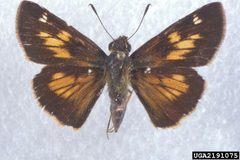
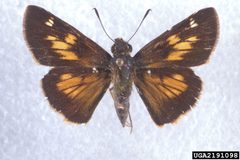
Distinguished from similar skippers by the combination of bright orange upperside with wide dark borders and three to five pale spots. The in hindwing underside coloration—dark brown in females versus orange in males—is a key identifying feature. Similar to other Poanes but differs in specific spot pattern and coloration details.
Images
Appearance
Wingspan 34–45 mm. Upperside bright orange with wide dark borders. Underside of hindwings dark brown in females, orange in males. Both sexes have three to five pale spots on the wings.
Habitat
Occurs in open, moist including wet meadows, marshes, and edges of streams and ponds. Associated with areas where larval plants (Arundinaria ) and nectar sources are present.
Distribution
Southeastern Virginia west to southwestern Missouri, south to eastern Texas, the Gulf Coast, and northern Florida.
Seasonality
are active from spring through fall, with multiple per year. Exact timing varies across the range.
Diet
feed on nectar from various flowers including sweet pepperbush (Clethra alnifolia), chinquapin (Castanea), pickerelweed (Pontederia cordata), and swamp milkweed (Asclepias incarnata). Larval diet presumably consists of Arundinaria , though this has not been confirmed.
Host Associations
- Arundinaria - probable larval Larvae probably feed on Arundinaria , but this relationship has not been definitively confirmed
Life Cycle
Multiple per year. laid on or near plants. Larvae feed on leaves, presumably of Arundinaria . occurs in leaf shelters or debris. emerge and feed on nectar.
Similar Taxa
- Poanes melaneSimilar and general appearance, but P. melane has umber brown wings with different spot pattern and lacks the bright orange upperside of P. yehl
- Other Poanes speciesShare characteristics but differ in wing coloration, spot patterns, and geographic distribution
More Details
Taxonomic Note
The was described by Skinner in 1893. It is placed in the Hesperiinae, the grass skippers.
Conservation Status
Not formally assessed; appears to be locally common within its range but may be vulnerable to loss in wetland areas.