
Poanes hobomok
(T.Harris, 1862)
Hobomok Skipper
The Hobomok Skipper is a North American grass skipper in the Hesperiidae. It is a riparian associated with forested streamside , where perch in dappled light and shade. The species exhibits two to three annually with activity from April through October in most of its range. Adults visit a variety of flowering plants for nectar.
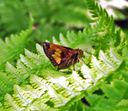
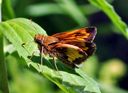
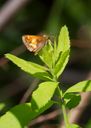
Pronunciation
How to pronounce Poanes hobomok: //poʊˈæniz ˈhoʊbəmɔk//
These audio files are automatically generated. While they are not always 100% accurate, they are a good starting point.
Identification
Distinguished from the similar Umber Skipper (Poanes melane) by geographic range and preferences; P. hobomok occurs in eastern North America while P. melane is western. Both share the characteristic umber brown wing coloration with pale spots on the forewing and a light yellow-brown band on the hindwing. Males have a more rapid, darting pattern compared to females. The Hobomok Skipper lacks the extensive urban seen in western of P. melane.
Images
Habitat
Riparian forest and streamsides with dappled light and shade; perches generally well above ground level. Associated with wooded corridors near water.
Distribution
Eastern North America; recorded from Vermont and presumably ranging more broadly in the northeastern United States. Not present in western North America where P. melane occurs.
Seasonality
Two to three annually; season approximately April through October, though timing varies by latitude and local conditions.
Behavior
perch in shaded, dappled light along streamsides, typically at some height above ground. Rapid, skipping characteristic of the .
Ecological Role
nectar feeding may contribute to pollination of visited flowers. Larval herbivory on grasses represents a trophic link in riparian .
Similar Taxa
- Poanes melaneExtremely similar in appearance and ; distinguished primarily by distribution (P. melane in western North America, P. hobomok in eastern North America) and context. P. melane has adapted extensively to urban lawns in the Bay Area, a not documented for P. hobomok.
- Poanes taxilesOverlapping range and similar riparian preferences; requires careful examination of wing pattern details for separation.