
Epargyreus clarus
(Cramer, 1775)
Silver-spotted Skipper
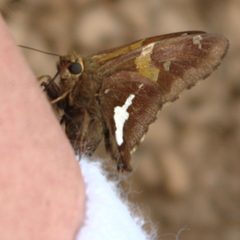
Epargyreus clarus, commonly known as the silver-spotted skipper, is one of the largest and most widespread skippers in North America. are readily identified by a prominent silver-white patch on the surface of each hindwing. The is multivoltine, with one to four per year depending on latitude, and exhibits strikingly higher pupal mortality during summer generations compared to generations. Larvae construct elaborate silk-lashed leaf shelters that provide limited protection from .
Pronunciation
How to pronounce Epargyreus clarus: //ɛˌpɑrˈdʒaɪr.i.əs ˈklɛər.əs//
These audio files are automatically generated. While they are not always 100% accurate, they are a good starting point.
Identification
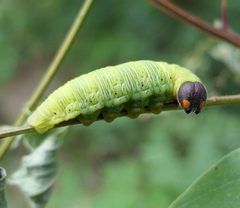
The large silver-white spot on the underside of the hindwing is diagnostic and visible even when wings are folded together over the back at rest. The yellow-orange patch on the forewing and dark brown ground color separate it from similar skippers. Male forewings are more pointed than female. Larvae are distinguished by the orange -spot mimicry on the , black first thoracic segment, and bright orange legs.
Images
Habitat
Open areas with nectar plants: forest edges, swamps, brushy areas, riparian , fields, and gardens. Prefers lower elevations and areas with partial shade for activity.
Distribution
Southern Canada through most of the United States to northern Mexico. Absent from the Great Basin and western Texas. Range expansion documented in Southern California with new county records.
Seasonality
fly from early to midsummer. One per year in the North and West, two in the East, three to four in the Deep South. pupae emerge in spring.
Diet
Larvae feed on leaves of Fabaceae (legumes), including: Amorpha fruticosa (false indigobush), Amphicarpaea bracteata (American hogpeanut), Apios americana (groundnut), Wisteria frutescens (American wisteria), Clitoria mariana (Atlantic pigeonwings), Desmodium tortuosum (Dixie ticktrefoil), Pueraria montana (kudzu), Robinia pseudoacacia (black locust), Wisteria sinensis (Chinese wisteria), and soybean (Glycine max). use a long to feed on nectar of blue, red, pink, purple, white, and cream flowers; also mud and animal . Rarely visit yellow flowers. Preferred nectar sources include everlasting pea, common milkweed, red clover, buttonbush, blazing star, and thistles.
Host Associations
- Amorpha fruticosa - larval false indigobush
- Amphicarpaea bracteata - larval American hogpeanut
- Apios americana - larval groundnut
- Wisteria frutescens - larval American wisteria
- Clitoria mariana - larval Atlantic pigeonwings / pea
- Desmodium tortuosum - larval Dixie ticktrefoil, introduced
- Pueraria montana - larval kudzu, introduced
- Robinia pseudoacacia - larval black locust
- Wisteria sinensis - larval Chinese wisteria, introduced
- Glycine max - larval soybean, occasional minor pest
Life Cycle
Complete with , larva, pupa, and stages. Females lay single eggs on or near plants. Larvae progress through five instars, each constructing increasingly complex leaf shelters lashed with silk. First through third instars build simple two-cut shelters on single leaflets; fourth and fifth instars may use multiple leaflets. Larvae take breaks of approximately 30 minutes between construction steps, completing shelters in under 2.5 hours. occurs within final shelters or in leaf litter. Multivoltine: summer pupal stage lasts 10–14 days; pupal stage lasts several months. Three or more overlapping of hibernating pupae occur in Florida, fewer in northern regions.
Behavior
Larvae are feeders, hiding in silk-lashed leaf shelters during the day. They actively expel up to 38 body lengths away using an anal comb, likely to reduce detection. When disturbed, larvae regurgitate a greenish defensive chemical. exhibit perching : males defend territories 1–2 meters above ground on branches and tall weeds, darting at passing insects to locate receptive females. Territorial disputes involve swift, acrobatic . Adults rest on leaf undersides at night or during hot/cloudy days, hanging upside down with wings folded to expose the silver spot. Flight is rapid and erratic, typically restricted to shaded areas. Adults are .
Ecological Role
of diverse flowering plants, though often acts as a nectar thief—probing innermost disk florets (male organs) without contacting outermost florets (female organs), thus failing to pollinate in more than 50% of feedings. Larvae serve as prey for paper wasps (Polistes fuscatus, P. dominula), sphecid (Stictia carolina), and ants (Crematogaster opuntiae). Natural of , which manipulates larval to facilitate transmission.
Human Relevance
Minor pest of beans, soybean, and kidney bean, though damage rarely warrants control measures. Valued as a conspicuous and attractive in gardens and natural areas. Subject of ecological research on pupal survival, avoidance, and plant-insect interactions.
Similar Taxa
- Other Epargyreus speciesLack the prominent silver-white hindwing spot; E. clarus is the only North American with this feature.
- Other Hesperiidae skippersSmaller size, different wing patterns, lack the distinctive silver spot and yellow-orange forewing patch combination.
Sources and further reading
- BugGuide
- Wikipedia
- GBIF taxonomy match
- iNaturalist taxon
- NCBI Taxonomy
- Catalogue of Life
- Chrysalis Conundrum: Why One Butterfly Species' Pupae Fare Better in Winter Than Summer
- Gelechiidae | Beetles In The Bush
- WGNSS | Beetles In The Bush
- predator avoidance | Beetles In The Bush | Page 2
- economic pests | Beetles In The Bush
- Silver-Spotted Skipper; Epargyreus clarus (Cramer) (Insecta: Lepidoptera: Hesperidae: Pyrginae)
- Supplementary notes on the distribution of Epargyreus clarus in Southern California (Hesperiidae)