
Hesperia leonardus
Harris, 1862
Leonard's skipper
Species Guides
3- Hesperia leonardus leonardus(Eastern Leonard's Skipper)
- Hesperia leonardus montana(Mountain Skipper)
- Hesperia leonardus pawnee(Pawnee Skipper)
Hesperia leonardus, commonly known as Leonard's skipper, is a in the Hesperiidae native to North America. The comprises three with distinct geographic ranges: the nominate subspecies in the eastern and central United States and Canada, the Pawnee skipper (ssp. pawnee) in the Great Plains, and the Pawnee montane skipper (ssp. montana), which is to the South Platte River drainage in Colorado. are active in late summer and fall, with a single per year. The species has been documented feeding on specific grass species as larvae and nectar from particular flowering plants as adults.
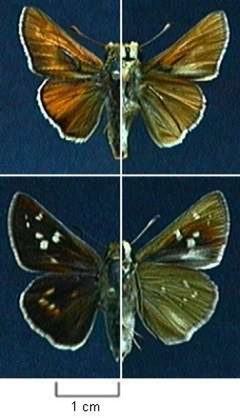
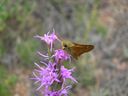
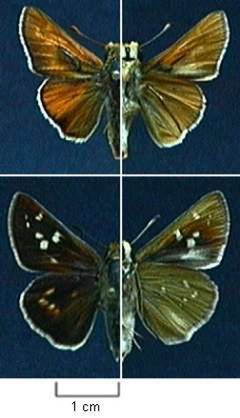
Pronunciation
How to pronounce Hesperia leonardus: //hɛsˈpɛɹiə liːoʊˈnɑːrdəs//
These audio files are automatically generated. While they are not always 100% accurate, they are a good starting point.
Identification
Distinguished from similar Hesperia by geographic distribution and . The nominate occurs in the eastern and central United States and Canada, while ssp. pawnee is found in the Great Plains from Montana and Saskatchewan to Colorado and Kansas. The subspecies ssp. montana is restricted to the South Platte River drainage in Colorado. fly from August to October, later than many . Specific wing pattern differences from related species such as Hesperia sassacus or Hesperia ottoe are not documented in available sources.
Images
Habitat
Associated with grassland and prairie . Larval plants include native grasses such as little bluestem (Andropogon scoparius), blue grama (Bouteloua gracilis), and bentgrass (Agrostis), suggesting open grassland or prairie with established native grass .
Distribution
North America. The nominate ranges from Nova Scotia and Maine west through southern Ontario and the Great Lakes region to Minnesota, south to North Carolina, Louisiana, and Missouri. Subspecies pawnee occurs from western Montana and southeastern Saskatchewan east to Minnesota, south to central Colorado and Kansas. Subspecies montana is to the South Platte River drainage of Colorado. Documented presence in Canadian provinces: Alberta, Manitoba, Saskatchewan; US states including Vermont.
Seasonality
One per year. are on wing from August to October, with peak activity in late summer and early autumn.
Diet
Larvae feed on various grasses including Andropogon scoparius (little bluestem), Bouteloua gracilis (blue grama), and Agrostis (bentgrass). feed on flower nectar from Liatris punctata (dotted blazing star), thistles (Cirsium spp.), asters (Symphyotrichum spp. and related ), and teasel (Dipsacus spp.).
Host Associations
- Andropogon scoparius - larval food plantLittle bluestem, a native prairie grass
- Bouteloua gracilis - larval food plantBlue grama, a native shortgrass prairie
- Agrostis - larval food plantBentgrass
- Liatris punctata - nectar sourceDotted blazing star
- Cirsium - nectar sourceThistles
- Symphyotrichum - nectar sourceAsters and related
- Dipsacus - nectar sourceTeasel
Life Cycle
One per year. Larvae feed on grasses. emerge in late summer and are active through October. details and stage are not documented in available sources.
Ecological Role
function as when feeding on nectar from flowers including Liatris punctata, thistles, asters, and teasel. Larvae are herbivores that consume native grasses, contributing to nutrient cycling in prairie .
Human Relevance
The Hesperia leonardus montana (Pawnee montane skipper) is of conservation concern due to its restricted range in the South Platte River drainage of Colorado. The has been studied in the context of prairie conservation and native grassland management.
Similar Taxa
- Hesperia sassacusSimilar size and preferences in overlapping range; specific distinguishing characters not documented in available sources
- Hesperia ottoePrairie-associated skipper with similar and requirements; specific distinguishing characters not documented in available sources
More Details
Subspecies
Three are recognized: Hesperia leonardus leonardus (nominate), Hesperia leonardus pawnee (Pawnee skipper), and Hesperia leonardus montana (Pawnee montane skipper or mountain skipper). The subspecies montana has a highly restricted distribution and may warrant specific conservation attention.
Taxonomic history
Described by Thaddeus William Harris in 1862. pawnee described by Dodge in 1874, and montana by Skinner in 1911.