
Hesperia sassacus
Harris, 1862
Indian Skipper
Hesperia sassacus, commonly known as the Indian skipper, is a small in the Hesperiidae. It occurs in northeastern North America, with a wingspan of 25–30 mm. fly from late May to early July. The has three recognized , with larvae feeding on various native grasses.
Pronunciation
How to pronounce Hesperia sassacus: /hɛˈspɛriə ˈsæsəkəs/
These audio files are automatically generated. While they are not always 100% accurate, they are a good starting point.
Images
Appearance
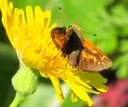
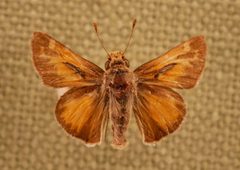
Wingspan 25–30 mm. A small with typical hesperiid : stocky body, large , and with hooked tips.
Distribution
Northeastern United States; southwestern New Brunswick, Canada; and a broad band from the Eastern Townships of Quebec through southern Manitoba.
Seasonality
Late May to early July ( period).
Diet
Larvae feed on nodding fescue (Festuca obtusa), poverty grass (Danthonia spicata), panic grass (Panicum), Bouteloua, Andropogon, Aristida, and other Poaceae . diet not specified in sources.
Host Associations
- Festuca obtusa - larval nodding fescue
- Danthonia spicata - larval poverty grass
- Panicum - larval panic grass
- Bouteloua - larval
- Andropogon - larval
- Aristida - larval
- Poaceae - larval grass
Similar Taxa
- Other Hesperia speciesSimilar size, period, and preferences; identification requires examination of wing pattern details and genitalia.
More Details
Subspecies
Three recognized: H. s. sassacus (nominate), H. s. manitoboides (Fletcher, 1889), and H. s. nantahala Gatrelle & Grkovich, 2003.
Etymology
The epithet 'sassacus' honors Sassacus, the last chief of the Pequot Indians of the Connecticut Valley.
Sources and further reading
- BugGuide
- Wikipedia
- GBIF taxonomy match
- iNaturalist taxon
- NCBI Taxonomy
- Catalogue of Life
- Bees and CAMBP Prevail at California Honey Festival | Bug Squad
- Bug Eric: Spider Sunday: Sassacus
- Bug Eric: A Case of Predator Mimicry in the Bee Fly Genus Epacmus? (Diptera: Bombyliidae)
- My Publications | Beetles In The Bush