
Hesperia juba
(Scudder, 1872)
Juba skipper, Yuba skipper, jagged-border skipper
Hesperia juba, commonly known as the Juba skipper, Yuba skipper, or jagged-border skipper, is a in the Hesperiidae. It occurs in western North America from British Columbia through California and eastward to the Rocky Mountain states. The has two per year, with active in late spring and again in late summer. Larvae develop on specific grass species, while adults feed on flower nectar.
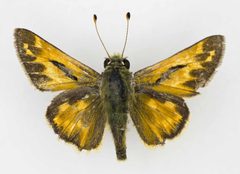
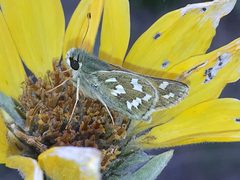
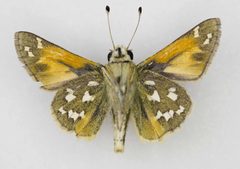
Pronunciation
How to pronounce Hesperia juba: /hɛsˈpɛriə ˈdʒuːbə/
These audio files are automatically generated. While they are not always 100% accurate, they are a good starting point.
Identification
The can be distinguished from similar Hesperia skippers by its jagged wing border pattern. Accurate identification may require examination of genitalia or reference to regional field guides.
Images
Appearance
Wingspan 32–42 mm. The 'jagged-border skipper' refers to characteristic markings on the wing margins.
Habitat
Grassland and open in western North America, including montane and foothill regions.
Distribution
North America: British Columbia south to southern California, east to Montana, Wyoming, Colorado, and northwestern New Mexico.
Seasonality
Two per year. on wing from May to June, and again from August to September.
Diet
Larvae feed on Deschampsia elongata, Stipa, Bromus rubens, and Poa pratensis. feed on flower nectar, including rabbitbrush (Ericameria/Chrysothamnus spp.).
Host Associations
- Deschampsia elongata - larval food plantslender hairgrass
- Stipa - larval food plant of needlegrasses
- Bromus rubens - larval food plantfoxtail brome, red brome
- Poa pratensis - larval food plantKentucky bluegrass
- Ericameria/Chrysothamnus - nectar sourcerabbitbrush
Life Cycle
(two per year). Larvae develop on grass plants. and details not specified in available sources.
Ecological Role
function as when feeding on nectar. Larvae are herbivores on native and introduced grasses.
Human Relevance
No significant economic or conservation importance documented. Subject of interest to enthusiasts and researchers in western North America.
Similar Taxa
- Hesperia commaOverlapping range in western North America; requires careful examination of wing pattern and genitalia for separation
- Hesperia coloradoSimilar and distribution; boundaries may require expert verification
More Details
Nomenclature
The epithet 'juba' refers to the Juba River or region, though the precise etymology is not documented in the provided sources. The basionym Pamphila juba Scudder, 1872 reflects historical classification in a now-synonymized .
Common Name Variants
'Yuba skipper' appears to be an alternative spelling or regional variant of 'Juba skipper' rather than a distinct .