
Hesperia dacotae
(Skinner, 1911)
Dakota skipper
Hesperia dacotae, the Dakota skipper, is a small to medium-sized North American in the Hesperiidae. are active for approximately three weeks during June and July, their entire lifespan. The inhabits native tallgrass prairie and has experienced significant declines due to prairie destruction and modification. Listed as Threatened under the U.S. Act since 2014, it has been extirpated from Illinois and Iowa, with its largest remaining population in North Dakota.
Pronunciation
How to pronounce Hesperia dacotae: /hɛˈspɪəriə dəˈkoʊti/
These audio files are automatically generated. While they are not always 100% accurate, they are a good starting point.
Identification
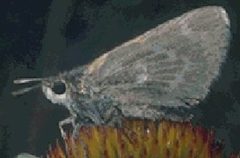
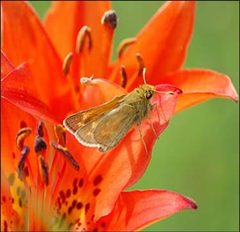
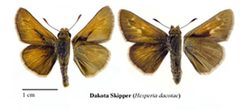
Small with wingspan of approximately one inch. terminate in a distinct hook, characteristic of Hesperiidae. Males: forewings tawny-orange to brown with prominent marking, hindwings dusty yellow on lower portion. Females: darker brown-orange forewings with white spots along forewing margin.
Images
Habitat
Healthy native tallgrass prairie and prairie grasslands. Requires intact prairie vegetation structure.
Distribution
North American prairies from Minnesota to Saskatchewan, Canada. Largest stable in North Dakota. Extirpated from Illinois and Iowa. Historical range included additional prairie states.
Seasonality
period restricted to three weeks in June and July. laid in July; larvae feed through late summer before entering dormancy.
Diet
Larvae feed on native grasses. Specific grass not documented in available sources.
Life Cycle
laid on undersides of leaves in July. Larvae hatch and feed on native grasses until late summer, then enter dormancy in shelters very close to ground level. Larvae overwinter in state. emerge from dormancy in spring, completing development to .
Ecological Role
herbivore of native prairie grasses; for intact tallgrass prairie health.
Human Relevance
Subject of conservation concern due to prairie loss. Listed as Threatened under U.S. Act (2014). Previously on Candidate list (1975–2014). Petitioned for protection in 1994 and 2003. Declining attributed to prairie conversion for grazing, herbicide use, and development.
Similar Taxa
- Hesperia speciesOther in same share hooked and similar size; distinguished by specific wing coloration patterns and geographic range
- Other Hesperiidae members share hooked ; Dakota skipper distinguished by prairie specificity and diagnostic wing markings