
Ancyloxypha arene
(Edwards, 1871)
Tropical Least Skipper
Ancyloxypha arene, commonly known as the Tropical Least Skipper, is a small grass in the Hesperiidae. It is one of the smallest skippers in North America. The occurs from the southern United States through Central America. are active throughout much of the year in tropical regions, with more restricted periods in temperate areas.
Pronunciation
How to pronounce Ancyloxypha arene: /ænˌsɪloʊˈkɪfə əˈriːneɪ/
These audio files are automatically generated. While they are not always 100% accurate, they are a good starting point.
Identification
The combination of small size (under 30 mm wingspan), bright orange coloration, and the distinctive pale ray on the underside of the hindwing separates this from other Ancyloxypha. The Least Skipper (Ancyloxypha numitor) is similar but has a darker, more brownish-orange hindwing underside without the prominent pale ray; it is also generally found in wetter, more eastern in North America.
Images
Appearance
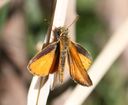
A small skipper with bright orange wings. The upperside of both forewing and hindwing has a narrow black border. The underside of the hindwing is golden orange with a distinctive pale ray running from the base through the to the outer margin. Wingspan ranges from 19 to 27 mm (0.75 to 1.06 inches).
Habitat
Open grassy areas including fields, meadows, roadsides, and disturbed . In the southern United States, it favors dry, open grasslands and prairie remnants. In tropical regions, it occupies a variety of open, sunny habitats with low vegetation.
Distribution
Southern United States (from southern California east to Florida and north to North Carolina), Mexico, Central America, and the Caribbean. It is the most widespread Ancyloxypha in the Neotropics.
Seasonality
Year-round in tropical portions of the range. In the southern United States, fly from spring through fall, with peak activity in summer months. Multiple occur annually where climate permits.
Behavior
fly low and weakly, staying close to the ground in grassy vegetation. They frequently rest with wings held in a characteristic skipper posture—forewings partially open, hindwings flat. Males perch on low vegetation to await females.
Similar Taxa
- Ancyloxypha numitorSimilar small orange skipper, but has darker hindwing underside lacking the prominent pale ray; also differs in preference, favoring wetter eastern meadows
- Copaeodes aurantiacaAnother small orange skipper, but has more extensive dark markings and lacks the pale hindwing ray; found in similar dry grassland in the southwestern United States
More Details
Taxonomic Note
This was originally described as Heteropterus arene by Edwards in 1871 before being transferred to Ancyloxypha.