
Dargida
Walker, 1856
wheat head armyworm moths
Species Guides
6- Dargida aleada(Wheat Head Armyworm)
- Dargida diffusa(Wheat Head Armyworm)
- Dargida grammivora
- Dargida procinctus(Girdler Moth)
- Dargida rubripennis(Pink Streak)
- Dargida tetera(Wheat Head Armyworm)
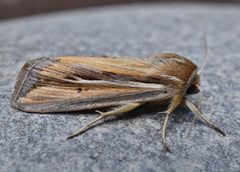
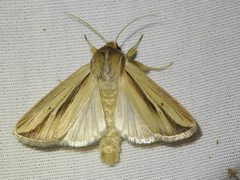
Dargida is a of noctuid containing approximately 50 described distributed primarily in the Americas. The genus includes several species whose larvae are known as wheat armyworms, significant agricultural pests of small grains. moths are medium-sized with wingspans of 1¼ to 1½ inches, typically yellow-brown with longitudinal stripes on the forewings. The genus was established by Francis Walker in 1856 and has historically included species formerly placed in the synonymized genus Faronta.
Pronunciation
How to pronounce Dargida: //ˈdar.ɡɪ.da//
These audio files are automatically generated. While they are not always 100% accurate, they are a good starting point.
Identification
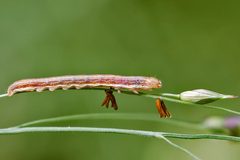
distinguished from similar noctuids by the combination of yellow-brown forewings with a single prominent lengthwise brown stripe and moderate size. Larvae identified by slender body form, greenish to tan coloration with three longitudinal stripes (yellow, white, brown) on each side, and association with wheat . Distinguished from fall armyworm (Spodoptera frugiperda) by lack of white inverted "Y" on head and four black spots on eighth abdominal segment. Distinguished from true (Mythimna unipuncta) by absence of net-like head pattern and dark band on outer side of . -level identification within Dargida requires examination of genitalia or specialized wing pattern details.
Images
Appearance
are medium-sized noctuids with wingspans of approximately 30–38 mm (1¼–1½ inches). Forewings are yellow-brown with a prominent lengthwise brown stripe. Hindwings are typically paler. Body is robust with typical noctuid . Larvae are slender, greenish to light tan, reaching up to 38 mm (1½ inches) at maturity. Larvae display yellow, white, and brown longitudinal stripes along each side of the body.
Habitat
Agricultural landscapes dominated by small grain crops, particularly wheat. Larvae occur in wheat fields, with concentrated along field margins and in dryland areas. associated with grassy and weedy fields where are deposited. includes temperate and subtropical regions supporting cereal agriculture.
Distribution
Primarily distributed in the Americas. Records from the United States (including Vermont and Texas), Mexico, Central America, and South America. The shows particular diversity in the Neotropical region. Distribution closely associated with major wheat-growing regions of North America.
Seasonality
emerge in spring to lay . First larval appears in late May and June, coinciding with wheat heading. Larval development continues through grain maturation. occurs in soil. Single or multiple generations per year depending on and latitude. In northern regions, likely single generation; southern may have partial second generation.
Diet
Larvae feed on developing kernels of wheat and other small grains, primarily targeting kernels in the soft dough stage. Some may feed on additional grasses (Poaceae). do not feed.
Host Associations
- Triticum aestivum - larval food plantprimary ; kernels in soft dough stage
- Poaceae - larval food plantsecondary grass
Life Cycle
Complete with four stages: , larva, pupa, . Eggs laid on or near plants in spring. Larvae feed on developing grain , with development timed to coincide with kernel soft dough stage. Larvae pupate in soil. Adults emerge after approximately 3–4 weeks. stage varies by , likely as pupa or larva in soil.
Behavior
Larvae are feeders, hiding in wheat or among plant debris during daylight hours. Larvae feed directly on kernels within wheat heads, causing damage that is often not apparent until after harvest. are nocturnal and attracted to light. Adults migrate to locate suitable oviposition sites in wheat fields.
Ecological Role
Primary consumer (herbivore) in agroecosystems. Larvae function as seed of cereal grains. Limited information available on natural enemies; likely preyed upon by predators and common in agricultural systems. Not known to play significant role in natural due to association with cultivated grains.
Human Relevance
Major agricultural pest of wheat in North America, particularly the Texas High Plains and similar wheat-growing regions. Larvae damage kernels directly, reducing yield and grain quality. Damage often detected post-harvest as hollowed-out kernels. Control complicated by pre-harvest interval restrictions on . not well established. Insecticides with short pre-harvest intervals (malathion, chlorantraniliprole) may be used when feasible. No significant beneficial uses documented.
Similar Taxa
- Mythimna unipunctaTrue ; larvae similar in size and habit but distinguished by net-like pattern and dark band on outer
- Spodoptera frugiperdaFall armyworm; larvae have diagnostic white inverted "Y" on and four black spots on eighth abdominal segment
- Euxoa auxiliaris; larvae are surface feeders that clip plants at soil surface rather than feeding in
More Details
Taxonomic synonymy
The Faronta Smith, 1908 is now treated as a synonym of Dargida, with formerly placed in Faronta transferred to Dargida.
Species diversity
The contains approximately 50 described , with Dargida procinctus (olive green cutworm) and Dargida terrapictalis being among the more frequently encountered in agricultural contexts.
Detection challenges
Larval damage is often cryptic, with hollowed kernels only apparent after harvest. This delayed detection complicates management decisions.