
Dargida rubripennis
(Grote & Robinson, 1870)
Pink Streak, Pink Streak Moth
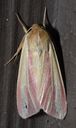
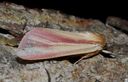
Dargida rubripennis, commonly known as the pink streak, is a in the Noctuidae. It was described by Augustus Radcliffe Grote and Coleman Townsend Robinson in 1870. The species is listed as threatened in Massachusetts and Connecticut. have a wingspan of 32–37 mm. The larvae are known as wheat armyworms and feed on developing wheat kernels, particularly in the soft dough stage.

Pronunciation
How to pronounce Dargida rubripennis: //ˈdɑːrɡɪdə ruːbrɪˈpɛnɪs//
These audio files are automatically generated. While they are not always 100% accurate, they are a good starting point.
Identification
can be recognized by the yellow-brown forewings with a distinct lengthwise brown stripe on each forewing. The wingspan of 32–37 mm helps distinguish it from similar . The larvae are slender, greenish to light tan, up to 1½ inches long, with yellow, white, and brown stripes running lengthwise on each side of the body.
Images
Appearance
have a wingspan of 32–37 mm. The forewings are yellow-brown with a lengthwise brown stripe. The 'pink streak' refers to coloration on the wings.
Habitat
Associated with agricultural fields, particularly wheat fields. Larvae feed in wheat . are heavier in dryland fields and on the edges of irrigated fields.
Distribution
Eastern United States, ranging west to Kansas and Texas. Specifically recorded as present in North America. Listed as threatened in Massachusetts and Connecticut.
Seasonality
emerge in spring and lay . First larvae appear in late May and June. Larval feeding occurs during kernel development, particularly targeting wheat in the soft dough stage.
Diet
Larvae feed on wheat kernels, primarily those in the soft dough stage. The larvae are known as wheat armyworms and damage developing grain.
Life Cycle
One per year. emerge in spring to lay . Larvae develop through late May and June, feeding on wheat . occurs in soil.
Behavior
Larvae feed within wheat , damaging kernels. often occur along field margins. Feeding damage is most evident after harvest, when hollowed out kernels become apparent.
Ecological Role
Human Relevance
Economic pest of wheat. Damage to kernels reduces yield and quality. No established treatment thresholds exist. Pre-harvest intervals for most make treatment timing difficult. Insecticides with malathion (7-day PHI) and chlorantraniliprole (1-day PHI) are among the few options with sufficiently short pre-harvest intervals. Listed as threatened in Massachusetts and Connecticut, indicating conservation concern in parts of its range.