
Dargida tetera
(Smith, 1902)
Wheat Head Armyworm
Dargida tetera is a noctuid in the Dargida, commonly known as a wheat head armyworm. The is part of a group of 13 similar-looking Dargida species whose larvae feed on wheat . It is found in North America and is considered a minor pest of wheat, particularly in the Texas High Plains region. The moth has a wingspan of approximately 1¼ to 1½ inches.
Pronunciation
How to pronounce Dargida tetera: //ˈdɑːrɡɪdə tɛˈtɛrə//
These audio files are automatically generated. While they are not always 100% accurate, they are a good starting point.
Identification
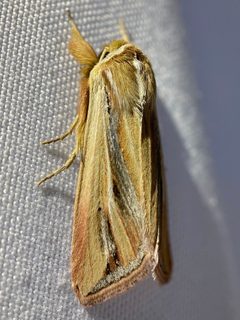
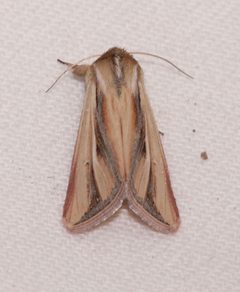
are distinguished by yellow-brown forewings with a lengthwise brown stripe. Larvae are identified by their slender build, greenish to light tan coloration, and the presence of yellow, white, and brown lengthwise stripes on each side of the body. Dargida tetera cannot be reliably distinguished from other Dargida by appearance alone; all 13 species in the have similar-looking larvae and moths. Identification to species level typically requires dissection and examination of genitalia or molecular methods.
Images
Habitat
Associated with wheat fields, particularly in dryland fields and edges of irrigated fields. Found in grassy agricultural environments where small grains are cultivated. Larvae feed within wheat .
Distribution
North America; specifically documented in the Texas High Plains and surrounding regions of the Great Plains. GBIF records indicate presence in North America.
Seasonality
emerge in spring to lay . First larvae appear in late May and June. occur as a late-season wheat pest.
Diet
Larvae feed on wheat kernels, primarily those in the soft dough stage. Feeding is concentrated in wheat .
Host Associations
- Triticum aestivum - larval food plantwheat; primary
Life Cycle
One per year. emerge in spring and lay . Larvae develop in late May and June, feeding in wheat . occurs in soil. emerge to complete the cycle.
Behavior
Larvae feed within wheat , damaging kernels. often occur along field margins and are heavier in dryland fields compared to fully irrigated fields. Larvae hide during the day and feed at night.
Ecological Role
Minor agricultural pest. Larval feeding reduces wheat kernel quality by hollowing out kernels, which becomes apparent after harvest. levels are generally not high enough to cause major economic damage.
Human Relevance
Considered a minor pest of wheat. Damage is most often noticed after harvest when hollowed kernels become apparent. No established exist for treatment. Pre-harvest intervals for most make chemical control difficult during the damage period. Insecticides with malathion (7-day PHI) and chlorantraniliprole (1-day PHI) may be options when treatment is warranted.
Similar Taxa
- Other Dargida species13 in Dargida (synonym Faronta) have larvae and that look similar; cannot be distinguished by appearance alone
- Euxoa auxiliaris; also a noctuid pest of small grains but larvae are surface feeders that cut plants at soil level rather than feeding in
- Pseudaletia unipunctaTrue ; larger, more destructive noctuid pest with different larval coloration and feeding habits
More Details
Taxonomic Note
Dargida tetera was originally described as Leucania tetera by Smith in 1902. The Dargida is sometimes treated as a synonym of Faronta in older literature.
Management Considerations
Because Dargida tetera is a minor pest with late-season timing, chemical control is rarely justified. The concealed feeding habit within wheat and pre-harvest interval restrictions limit practical treatment options.