
Leucania
Ochsenheimer, 1816
wainscot moths
Species Guides
28- Leucania adjuta(Adjutant Wainscot)
- Leucania amygdalina(Northern Linen Wainscot)
- Leucania anteroclara(cutworm moth)
- Leucania calidior(cutworm moth)
- Leucania commoides(Two-lined Wainscot)
- Leucania dia
- Leucania extincta(cutworm)
- Leucania farcta(Meadow Wainscot Moth)
- Leucania imperfecta(cutworm moth)
Leucania is a of noctuid established by Ochsenheimer in 1816, commonly known as wainscot moths. The genus is characterized by distinctive wing venation with 8 and 9 anastomosing to form an areole, and vein 7 arising from its terminal end. Several have been studied as agricultural pests, particularly Leucania loreyi and Leucania separata, which have been documented as for braconid . The genus has a broad geographic distribution with numerous species worldwide.
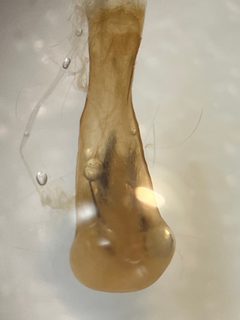
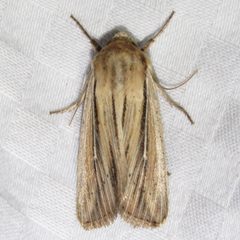
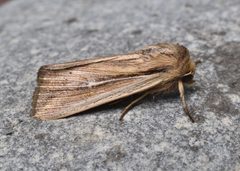
Pronunciation
How to pronounce Leucania: /luːˈkeɪniə/
These audio files are automatically generated. While they are not always 100% accurate, they are a good starting point.
Identification
Forewings with diagnostic venation: 8 and 9 fuse to form an areole, with vein 7 emerging from the end of this structure and vein 10 positioned before the end. Palpi obliquely upturned with second joint roughly scaled and prominent, third joint short, naked, and depressed. well developed. hairy. minutely ciliated in males. not deeply retracted into . Thorax smoothly scaled. with scarcely any tufts on basal segments. Tibia and bear short hairs.
Images
Distribution
Worldwide distribution with recorded across multiple continents; specific range varies by species.
Ecological Role
Larval for braconid including Apanteles kariyai and Microplitis mediator; parasitoid oviposition preference observed for older host larvae.
Human Relevance
Some documented as agricultural pests; studied in laboratory rearing for developmental and - interactions.
Sources and further reading
- BugGuide
- Wikipedia
- iNaturalist taxon
- NCBI Taxonomy
- Catalogue of Life
- Developmental Interaction Between Leucania separate (Lepidoptera: Noctuidae) and Its Braconid Parasitoid, Microplitis mediator (Hymenoptera: Braconidae)
- On the Biology of Leucania loreyi Dup. (Lepidoptera, Noctuidae)
- Effect of the number of parasitoid (Apanteles kariyai) eggs [Hym.: Braconidae] on the growth of host (Leucania separata) larvae [Lep.: Noctuidae]
- Supplementation of Maize- and Cowpea Seed-Based Artificial Diets with Diverse Pollen Sources Affects the Demographic Features of Leucania loreyi (Duponchel, 1827) (Lepidoptera: Noctuidae).
- The genome sequence of the Shoulder-striped Wainscot moth, Leucania comma Linnaeus, 1761.