
Caloptilia fraxinella
(Ely, 1915)
Ash Leaf Cone Roller, Ash Leaf Cone Roller Moth
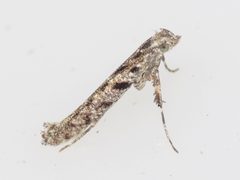
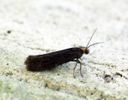
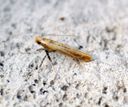
Caloptilia fraxinella is a leaf-mining in the Gracillariidae. Native to North America, it has become a significant pest of horticultural ash trees (Fraxinus spp.) in Canadian Prairie cities and parts of the United States. The exhibits an unusual with a 9-month reproductive ; adults eclose in summer, overwinter, and mate the following spring. Larvae mine ash leaves and eventually roll leaflets into cones for .
Pronunciation
How to pronounce Caloptilia fraxinella: //ˈkæloʊptɪliə ˌfræksɪˈnɛlə//
These audio files are automatically generated. While they are not always 100% accurate, they are a good starting point.
Identification
are small with typical Gracillariidae . Larvae are leaf miners with five instars; fourth-instar larvae are distinguished by their of dispersing from the mined leaflet to a new leaflet, which they roll into a cone for . This cone-rolling behavior is the source of the and distinguishes it from other Caloptilia that do not form such structures.
Images
Habitat
Urban forests and horticultural plantings of ash trees (Fraxinus spp.) in prairie and suburban environments. In its introduced range in the Canadian Prairie Provinces, it is associated with ornamental green ash (Fraxinus pennsylvanica) and black ash (F. nigra) in city plantings.
Distribution
Native to eastern North America: Canada (Québec, Ontario, Saskatchewan, Alberta) and United States (Michigan, Vermont, Ohio, Connecticut, New York, Maine). Introduced and established in urban forests of the Canadian Prairie Provinces, particularly Edmonton, Alberta.
Seasonality
eclose in July and enter reproductive . occurs as adults. Mating and oviposition occur in spring (May), timed to coincide with ash bud flush. Oviposition is constrained to a approximately 3-week period shortly after bud flush.
Diet
Larvae feed on Fraxinus (Fraxinus americana, F. mandshurica, F. nigra, F. pennsylvanica) and Ligustrum species. They mine the leaves of their plant. have been observed feeding on sources including sucrose solutions and buckwheat (Fagopyrum esculentum) flowers in laboratory studies.
Host Associations
- Fraxinus pennsylvanica - larval (green ash)Primary in Canadian Prairie urban forests
- Fraxinus nigra - larval (black ash) in introduced range
- Fraxinus americana - larval
- Fraxinus mandshurica - larval
- Ligustrum - larval level association
- Apanteles polychrosidis - primary Native braconid that has shifted to this in Edmonton, Alberta; primary agent
Life Cycle
Five larval instars. Fourth-instar larvae disperse from the mined leaflet to a new leaflet, roll it into a cone, and pupate within. eclose from rolled leaf cones. Adult lifespan is extended by a 9-month reproductive ; occurs in July, with in reproductive diapause until spring mating.
Behavior
Mated females orient to volatile organic chemicals (VOCs) released from ash seedlings for location. Male response to female is plastic and most acute when reproductively active in spring. overwinter in sheltered locations. Females show oviposition site preference for lower and south side of trees during early and mid-oviposition periods.
Ecological Role
Herbivore and on ash trees. In its introduced range in prairie cities, it functions as a pest of urban forest trees. Serves as for native Apanteles polychrosidis, which has shifted to exploit this .
Human Relevance
Significant pest of horticultural and ornamental ash trees in Canadian Prairie cities. Damage from leaf mining and cone-rolling affects aesthetic value of urban plantings. Subject of research and efforts using . use is undesirable in urban centers, making biological control preferred.
Similar Taxa
- Other Caloptilia speciesMany Caloptilia are leaf miners on various plants; C. fraxinella is distinguished by cone-rolling and specific association with Fraxinus hosts
- Caloptilia blandellaWalnut-feeding with different association (Juglans vs. Fraxinus)
Sources and further reading
- BugGuide
- Wikipedia
- GBIF taxonomy match
- iNaturalist taxon
- NCBI Taxonomy
- Catalogue of Life
- Bug Eric: Remembering National Moth Week 2018
- Bug Eric: It's National Moth Week Already?!
- Bug Eric: October 2018
- The use of plant volatiles for host location by an ash (Fraxinus) specialist, Caloptilia fraxinella
- Provision of carbohydrate resources to support Apanteles polychrosidis, to increase parasitism of Caloptilia fraxinella in horticultural ash trees
- Size and protein content of accessory glands in adult male Caloptilia fraxinella in different physiological states
- Biology of Caloptilia fraxinella (Lepidoptera: Gracillariidae) on ornamental green ash, Fraxinus pennsylvanica (Oleaceae)
- State-Dependent Plasticity in Response to Host-Plant Volatiles in a Long-Lived Moth, Caloptilia fraxinella (Lepidoptera: Gracillariidae)
- Host Plant Volatile Lures Attract Apanteles polychrosidis (Hymenoptera: Braconidae) to Ash Trees Infested With Caloptilia fraxinella (Lepidoptera: Gracillariidae)
- The roles of juvenile hormone and biogenic amines on pheromone response plasticity and diapause termination in male Caloptilia fraxinella
- Nutrition, sex and season contribute to variation in fat and glycerol levels in the long‐lived moth Caloptilia fraxinella