
Caloptilia
Hübner, 1825
leaf cone moths, leaf blotch miner moths
Species Guides
47- Caloptilia acerifoliella
- Caloptilia agrifoliella
- Caloptilia alnicolella
- Caloptilia alnivorella(Alder Leafminer)
- Caloptilia anthobaphes
- Caloptilia atomosella
- Caloptilia azaleella(Azalea Leafminer Moth)
- Caloptilia belfragella(Dogwood Caloptilia Moth)
- Caloptilia bimaculatella(Maple Caloptilia Moth)
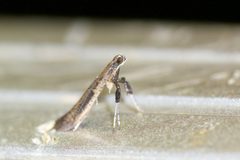
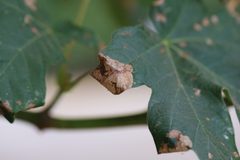
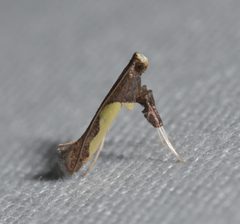
Caloptilia is a of small in the Gracillariidae, commonly known as leaf cone moths or leaf blotch miner moths. Larvae are leaf miners that typically feed internally on leaf tissue during early instars, then later instars roll or fold leaves into protective cones or shelters where they complete development and pupate. The genus contains numerous , many of which are -specific to particular tree or shrub genera. Several species have become economically significant as pests of ornamental and horticultural plants, including Caloptilia fraxinella on ash trees and Caloptilia azaleella on azaleas.
Pronunciation
How to pronounce Caloptilia: //ˌkæl.əpˈtɪl.i.ə//
These audio files are automatically generated. While they are not always 100% accurate, they are a good starting point.
Identification
identification within Caloptilia requires examination of male and female genitalia. The is characterized by with narrow, often pointed wings held roof-like over the body at rest, and relatively long . Larval mines typically begin as serpentine or blotch mines on the upper or lower leaf surface, progressing to rolled or folded leaf shelters in later instars. Specific identification from similar Gracillariidae genera depends on genitalic and plant association.
Images
Habitat
occur in supporting their plants, which include deciduous and evergreen trees and shrubs in forests, woodlands, suburban landscapes, and horticultural settings.
Distribution
Widespread across North America, Europe, Asia, and Australasia. Specific distribution varies by ; records include Canada, USA, Japan, Korea, China, Belarus, Belgium, Britain, Czech Republic, Denmark, Finland, France, Germany, Italy, Netherlands, Sweden, Switzerland, Australia, and New Zealand.
Seasonality
activity varies by and latitude. Caloptilia fraxinella males eclose in July and enter reproductive , becoming reproductively active the following May. Multiple Caloptilia species on maples show phenological peaks in July and September–October.
Diet
Larvae feed on leaves of trees and shrubs. Documented associations include: Fraxinus (ash), Acer (maple), Syringa (lilac), Ligustrum (privet), Rhynchosia (fabaceous vine), Aesculus (horse chestnut), Azalea, Glochidion, and Triadica sebifera (Chinese tallow). Many appear host-specific.
Host Associations
- Fraxinus - larval C. fraxinella, C. cuculipennella
- Acer - larval multiple sympatric
- Syringa - larval C. syringella
- Ligustrum - larval C. syringella
- Rhynchosia tomentosa - larval C. rhynchosiae, -specific
- Aesculus chinensis - larval C. aesculi, first report for Gracillariinae
- Azalea - larval C. azaleella
- Glochidion billardierei - larval gall-inducing in New Caledonia
- Triadica sebifera - larval Chinese tallow in North America
Life Cycle
are laid on plant leaves, often timed with bud flush. Larvae pass through five instars: early instars are leaf miners feeding internally within leaf tissue; fourth instar larvae disperse from the mined leaflet to a new leaflet, which they roll into a cone or fold; occurs within this shelter. eclose from rolled leaf cones. In C. fraxinella, males eclose in July, enter reproductive , and overwinter to become reproductively active the following May.
Behavior
Larvae construct characteristic leaf rolls, cones, or stacks as shelters for final instar feeding and . are attracted to ultraviolet light. Some induce galls rather than simple leaf rolls.
Ecological Role
Herbivores that mine and roll leaves of woody plants. Serve as for ; C. fraxinella has an overall rate of 46.4% by wasps in four , with Apanteles polychrosidis as a primary parasitoid. Multiple Caloptilia coexisting on shared maple hosts show considerable phenological overlap and largely overlapping parasitoid , suggesting partitioning is not required for coexistence.
Human Relevance
Several are significant pests of ornamental and horticultural plants. Caloptilia fraxinella is an introduced pest of horticultural ash trees in Canadian Prairie cities. Caloptilia azaleella damages azaleas. Management approaches include through provision of resources for .
Similar Taxa
- PhyllonorycterAlso Gracillariidae with leaf-mining larvae, but typically form tentiform mines on leaf undersides rather than rolling leaves into cones; pupates within the mine rather than in a rolled leaf shelter.
- CamerariaGracillariidae leaf miners that form blotch mines, but do not construct the characteristic rolled leaf cones of Caloptilia; occurs within the mine.
Sources and further reading
- BugGuide
- Wikipedia
- GBIF taxonomy match
- iNaturalist taxon
- NCBI Taxonomy
- Catalogue of Life
- Bug Eric: Remembering National Moth Week 2018
- Bug Eric: It's National Moth Week Already?!
- Bug Eric: October 2018
- Caloptilia syringella . [Distribution map].
- Caloptilia azaleella . [Distribution map].
- A new species of Caloptilia (Lepidoptera: Gracillariidae) from Japan and Korea
- Patterns of temporal and enemy niche use by a community of leaf cone moths ( Caloptilia ) coexisting on maples ( Acer ) as revealed by metabarcoding
- New record of Caloptilia cuculipennella (Hübner, 1796) in Belarus (Lepidoptera: Gracillariidae)
- A new leaf-mining moth, Caloptilia aesculi, sp. nov. (Lepidoptera: Gracillariidae: Gracillariinae) feeding on Aesculus chinensis Bunge (Hippocastanaceae) from China
- The use of plant volatiles for host location by an ash (Fraxinus) specialist, Caloptilia fraxinella
- Provision of carbohydrate resources to support Apanteles polychrosidis, to increase parasitism of Caloptilia fraxinella in horticultural ash trees
- Biology of Caloptilia fraxinella (Lepidoptera: Gracillariidae) on ornamental green ash, Fraxinus pennsylvanica (Oleaceae)
- Size and protein content of accessory glands in adult male Caloptilia fraxinella in different physiological states
- Using Internet Images to Gather Distributional Data for a Newly Discovered Caloptilia Species (Lepidoptera: Gracillariidae) Specializing on Chinese Tallow in North America
- Two new species of Caloptilia (Lepidoptera, Gracillariidae) from New Caledonia inducing galls on Glochidion billardierei (Phyllanthaceae) and redescription of C. xanthopharella (Meyrick, 1880).