
Caloptilia bimaculatella
(Ely, 1915)
Maple Caloptilia Moth
Caloptilia bimaculatella is a small leaf-mining in the Gracillariidae. It is known from eastern North America, with records from Canada (Ontario, Québec, Nova Scotia) and the eastern United States. The has a wingspan of 9–10 mm. Larvae feed on red maple (Acer rubrum), creating blotch mines in the leaves.
Pronunciation
How to pronounce Caloptilia bimaculatella: /kæˌlɒpˈtɪliə baɪˌmækjʊləˈtɛlə/
These audio files are automatically generated. While they are not always 100% accurate, they are a good starting point.
Identification
The combination of small size (9–10 mm wingspan), association with Acer rubrum as plant, and geographic range in eastern North America helps distinguish this . Within the Caloptilia, identification to species level typically requires examination of genitalia or , as many species are similar in external appearance. The specific epithet suggests two small spots on the forewings may be diagnostic, but this requires verification. Larval mines on red maple leaves can be identified to genus level; species-level identification of larvae is difficult without rearing to .
Images
Appearance
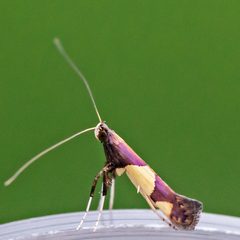
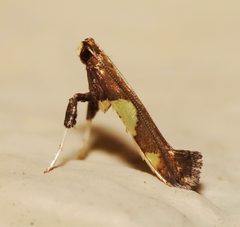
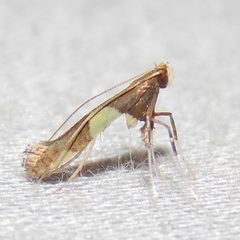
Small with wingspan of 9–10 mm. are typical of the Caloptilia, with narrow, elongate wings that are often held in a characteristic steep roof-like posture when at rest. The specific epithet "bimaculatella" (meaning "two small spots") likely refers to distinct markings on the forewings, though detailed pattern descriptions are not available in the provided sources.
Habitat
Associated with forests and wooded areas where the plant red maple (Acer rubrum) occurs. Red maple is a widespread in eastern North American forests, occurring in moist to wet soils in mixed hardwood forests, swamps, and riparian zones. The 's is therefore tied to the distribution and abundance of this host tree.
Distribution
Eastern North America. Canada: Ontario, Québec, Nova Scotia. United States: Florida, Kentucky, Maine, Michigan, Missouri, New York, Vermont, Connecticut, West Virginia, and other Atlantic States. The distribution corresponds closely to the range of its plant Acer rubrum.
Seasonality
have been recorded during National Week events in late July, suggesting summer activity. Specific details are not well documented, but like many Caloptilia , there may be multiple per year with adults active from late spring through summer.
Diet
Larvae feed on red maple (Acer rubrum). They mine the leaves of their plant, creating blotch mines. feeding habits are not documented.
Host Associations
- Acer rubrum - larval plantRed maple; larvae mine leaves
Life Cycle
Larvae are leaf miners on Acer rubrum, feeding internally within the leaf tissue and creating blotch mines. The complete has not been described in detail, but Gracillariidae typically have multiple per year. likely occurs within the mine or in a silken cocoon on the leaf surface. stage is not documented for this .
Behavior
are and attracted to ultraviolet light. Larvae are endophagous leaf miners, feeding between the upper and lower of maple leaves. When disturbed, Caloptilia larvae typically exit their mines and pupate in a silken fold or roll on the leaf margin, a characteristic of the .
Ecological Role
As a , larvae contribute to herbivory pressure on red maple . The mining damage is generally minor and not considered ecologically significant. The serves as a food source for and other natural enemies, though specific parasitoid records are not documented. It is part of the diverse of microlepidoptera that process leaf material in deciduous forests.
Human Relevance
Not of economic importance. Occasionally observed by citizen scientists during -lighting events such as National Moth Week. The is not considered a pest of ornamental or commercial maple plantings due to its restricted association with native red maple and limited damage.
Similar Taxa
- Caloptilia blandellaAnother Caloptilia with similar size and appearance; distinguished by plant association (walnut, Juglans) and geographic overlap in eastern North America
- Other Caloptilia species on AcerSeveral Caloptilia feed on maple species; accurate identification requires examination of genitalia or molecular methods
- Phyllonorycter speciesOther Gracillariidae that mine maple leaves; typically create linear or tentiform mines rather than blotch mines, and often have different resting posture
More Details
Etymology
The specific epithet "bimaculatella" derives from Latin "bi-" (two) + "macula" (spot) + diminutive suffix "-ella", referring to two small spots on the forewings.
Taxonomic history
Originally described as Lithocolletis bimaculatella by Ely in 1915, later transferred to the Caloptilia.