
Caloptilia blandella
(Clemens, 1864)
Walnut Caloptilia Moth
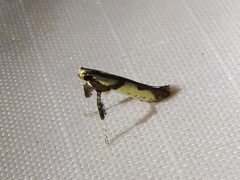
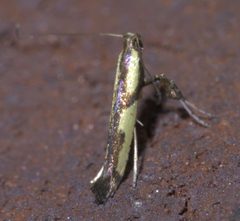
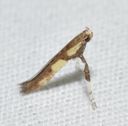
Caloptilia blandella is a small in the Gracillariidae, commonly known as the Walnut Caloptilia Moth. It has a wingspan of approximately 9 mm. The is distributed across eastern North America, with records from Canada (Québec) and several U.S. states including Pennsylvania, Virginia, Maine, Maryland, Texas, and Kentucky. Larvae are leaf miners that feed on shagbark hickory (Carya ovata) and black walnut (Juglans nigra).
Pronunciation
How to pronounce Caloptilia blandella: /kæ.lɒpˈtɪ.liə blænˈdɛl.ə/
These audio files are automatically generated. While they are not always 100% accurate, they are a good starting point.
Identification
The extremely small size (9 mm wingspan) and association with walnut and hickory plants are key identifying features. As a member of the Caloptilia, it can be distinguished from similar leaf-mining by its specific host plant relationships with Carya ovata and Juglans nigra. Definitive identification may require examination of genitalia or molecular analysis.
Images
Appearance
Small with wingspan of approximately 9 mm. Specific coloration and pattern details are not well documented in available sources.
Habitat
Associated with deciduous forests and woodlands containing trees, specifically shagbark hickory (Carya ovata) and black walnut (Juglans nigra). The has been observed in suburban settings where host trees are present.
Distribution
Eastern North America. Canada: Québec. United States: Pennsylvania, Virginia, Maine, Maryland, Texas, and Kentucky. Distribution records also include Ontario, Canada.
Seasonality
have been observed in July during National Week events. Specific period details are limited in available sources.
Diet
Larvae feed on leaves of Carya ovata (shagbark hickory) and Juglans nigra (black walnut). They mine the leaves of their plant. feeding habits are not documented.
Host Associations
- Carya ovata - larval shagbark hickory
- Juglans nigra - larval black walnut
Life Cycle
Larvae are leaf miners that feed internally within leaves of plants. Details of , pupal, and stages are not well documented. The likely follows the typical pattern for Gracillariidae, with complete through egg, larva, pupa, and adult stages.
Behavior
are attracted to ultraviolet light sources. Larvae create leaf mines in plant foliage. No other specific are documented in available sources.
Ecological Role
As a , larvae may influence leaf physiology and nutrient cycling in trees. The serves as a component of forest biodiversity. Specific ecological impacts are not quantified in available literature.
Human Relevance
Minor significance. The is not known to be an agricultural or forestry pest. It is encountered by citizen scientists during -watching events and contributes to biodiversity documentation.
Similar Taxa
- Other Caloptilia speciesMany Caloptilia are small leaf-mining with similar ; identification requires plant association or detailed examination.
- Other Gracillariidae members share small size and leaf-mining habits; plant specificity helps distinguish C. blandella.
More Details
Taxonomic history
Described by Clemens in 1864. The has been relatively understudied compared to economically important Lepidoptera.
Citizen science observations
The has been documented 1,525 times on iNaturalist, indicating it is regularly encountered by observers in its range.