
Caloptilia belfragella
(Chambers, 1875)
Dogwood Caloptilia Moth
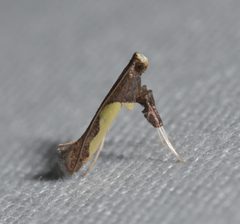
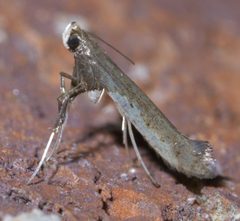
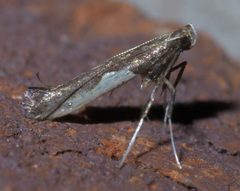
Caloptilia belfragella is a small in the Gracillariidae, commonly known as the Dogwood Caloptilia Moth. Its larvae are leaf miners that feed on several plants including dogwoods (Cornus), staghorn sumac (Rhus typhina), and blueberries (Vaccinium). The occurs in eastern North America from Quebec south to Texas.
Pronunciation
How to pronounce Caloptilia belfragella: /ˌkæˌlɒptɪˌliːə bɛlfɹəˈɡɛlə/
These audio files are automatically generated. While they are not always 100% accurate, they are a good starting point.
Identification
As a member of the Caloptilia, have characteristic narrow wings with pointed tips and a resting posture that gives them a distinctive triangular or tent-like silhouette. Specific identification to level requires examination of genitalia or detailed wing pattern analysis; the species is part of a complex group of similar Caloptilia that require determination.
Images
Habitat
Associated with containing its plants: woodlands, forest edges, and shrublands where dogwoods (Cornus), sumacs (Rhus), and blueberries (Vaccinium) occur.
Distribution
Eastern North America: Quebec, Canada; United States including Texas, Maine, Kentucky, Ohio, Illinois, and Michigan. GBIF records also indicate occurrences in Ontario, Florida, and Atlantic States.
Diet
Larvae feed on Rhus typhina (staghorn sumac), Cornus including Cornus asperifolia and Cornus drummondii (roughleaf dogwood and Drummond's dogwood), and Vaccinium species (blueberries). do not feed.
Host Associations
- Rhus typhina - larval plantstaghorn sumac
- Cornus asperifolia - larval plantroughleaf dogwood
- Cornus drummondii - larval plantDrummond's dogwood
- Vaccinium - larval plantblueberries
Life Cycle
Larvae mine the leaves of plants, creating characteristic blotch mines or serpentine mines within leaf tissue. occurs within the mine or in a silken cocoon on the leaf surface. Multiple per year are likely given the extended period typical of Caloptilia in temperate regions.
Behavior
are and attracted to light. Larvae are internal feeders, mining between the upper and lower of leaves.
Ecological Role
As a , larvae create feeding galleries that may affect photosynthetic capacity of plants, though typically not causing significant damage to healthy plants. The contributes to the complex of herbivores that process leaf in woodland .
Human Relevance
Minor economic significance; may occasionally be noticed on ornamental dogwoods or blueberry plantings, but not considered a serious pest. The is documented through citizen science platforms including iNaturalist.
Similar Taxa
- Caloptilia blandellaWalnut Caloptilia Moth; similar size and wing shape, but associated with Juglans (walnut) rather than Cornus, Rhus, or Vaccinium
- Other Caloptilia speciesNumerous in eastern North America require genitalia dissection or molecular analysis for reliable identification; many share similar external and resting posture
More Details
Taxonomic history
Originally described as Gracilaria belfragella by Chambers in 1875, later transferred to the Caloptilia. The basionym reflects the historical classification within Gracillariidae.
Observation frequency
iNaturalist records 444 observations as of data compilation, indicating it is moderately well-documented through citizen science, though likely underrecorded due to small size and need for identification.