
Aproaerema
Durrant, 1897
Species Guides
3Aproaerema is a of gelechiid moths in the Anacampsinae. The genus contains at least 11 described distributed across Africa, Asia, and Europe. Several species are significant agricultural pests, notably Aproaerema modicella (groundnut ), which causes severe yield losses in groundnut and soybean crops across South and Southeast Asia and has recently invaded Africa. The genus has been subject to taxonomic revision, with molecular and behavioral evidence suggesting relationships among A. modicella, A. simplexella, and related require re-examination.
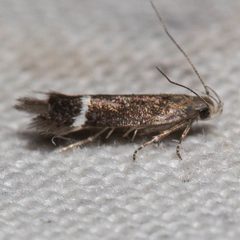
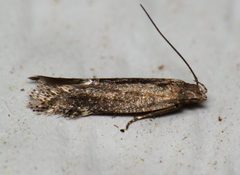
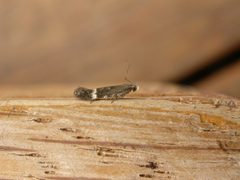
Pronunciation
How to pronounce Aproaerema: //ˌæpɹoʊˈɛɹəmə//
These audio files are automatically generated. While they are not always 100% accurate, they are a good starting point.
Identification
Identification of Aproaerema requires examination of genitalia and wing pattern details. Aproaerema modicella and A. simplexella have been historically confused and may represent closely related or ; molecular evidence suggests their warrants re-examination. are small gelechiid moths with narrow, pointed forewings typical of the . Species-level identification relies on subtle differences in wing pattern, particularly the arrangement and intensity of dark markings on the forewings, and dissection of male genitalia.
Images
Habitat
occur in agricultural , grasslands, and open . Aproaerema modicella is strongly associated with leguminous crop fields, particularly groundnut and soybean . The includes species adapted to both irrigated and rainfed agricultural systems, with some species recorded from natural vegetation including leguminous plants.
Distribution
The has a broad distribution spanning Europe, Africa, and Asia. GBIF records indicate presence in Denmark, Norway, and Sweden. Aproaerema modicella is native to South and Southeast Asia (India, Southeast Asia) and has invaded Africa since 1998, with confirmed records from Uganda, Mozambique, Malawi, Democratic Republic of Congo, and South Africa. Other have more restricted ranges: A. africanella occurs in Africa, A. anthyllidella in Europe, and A. brevihamata and A. longihamata in China.
Seasonality
Activity patterns vary by and region. Aproaerema modicella in India show seasonal peaks during June-August (monsoon period), with parasitization rates reaching maximum levels during July-August. In Tamil Nadu, activity monitored by traps peaks during the 9th Standard Mean Week (late February-early March). Development is temperature-dependent, with 660 required for complete above threshold temperatures of 11.3-14.7°C.
Diet
Larvae feed on leguminous plants. Aproaerema modicella is a feeder on groundnut (Arachis hypogaea) and soybean (Glycine max), with larvae mining leaves and causing up to 100% yield loss in severe . A. anthyllidella feeds on Anthyllis (kidney vetch). A. simplexella has been recorded from groundnut. Laboratory studies indicate soybean supports better larval development than groundnut for A. modicella, with higher and survival rates.
Host Associations
- Arachis hypogaea - primary groundnut/peanut; major crop for A. modicella
- Glycine max - primary soybean; principal for A. modicella, supports superior larval development
- Cajanus cajan - alternate redgram; recorded as alternate for A. modicella in India with 38% damage potential
- Psoralea corylifolia - alternate babchi; recorded as alternate for A. modicella with 20% parasitization rate
- Anthyllis vulneraria - kidney vetch; for A. anthyllidella
Life Cycle
Complete with , larval, pupal, and stages. Aproaerema modicella has five larval instars based on capsule width measurements. Development is temperature-dependent: egg threshold 12.4°C, larval threshold 11.3°C, pupal threshold 14.7°C. Total requires 660 above threshold. Egg production is greatest at 30°C and declines at lower and higher temperatures. Larval and pupal periods are shorter on soybean than groundnut. Adult longevity and are influenced by temperature and female age.
Behavior
Larvae are leaf miners, feeding internally within leaf tissue and creating characteristic mines. females select oviposition sites based on plant chemical cues and structural traits, though specific mechanisms remain poorly understood. Research suggests a potential mismatch between female oviposition choice and subsequent larval performance, indicating complexity in host suitability assessment. Adults are attracted to traps for monitoring purposes.
Ecological Role
Aproaerema modicella functions as a significant herbivore in agricultural , capable of reaching densities. The supports a diverse , with over 30 primary parasitoid species recorded in Asia. Mean rates fluctuate between 20-50%, with peaks reaching 53-91%. Major parasitoid include Goniozus (Bethylidae), Apanteles, Bracon, Chelonus, Avga (Braconidae), Brachymeria (Chalcididae), and Stenomesius, Sympiesis, Tetrastichus (Eulophidae). and are poorly studied. The high parasitoid diversity suggests the species occupies an important position in dynamics of legume agroecosystems.
Human Relevance
Several Aproaerema are major agricultural pests. Aproaerema modicella causes 50-100% yield loss in groundnut in India and has become a serious pest in African groundnut production since 1998. The species is considered a promising target for in Africa using Asian natural enemies. Management relies heavily on chemical , though using and introduced is increasingly studied. Understanding weather influences on (maximum temperature positively correlated, rainfall negatively correlated) supports predictive management. Taxonomic uncertainty between A. modicella and A. simplexella complicates pest management and decisions.
Similar Taxa
- Stomopteryx subsecivellaHistorically confused with Aproaerema modicella; molecular and behavioral evidence suggests taxonomic relationships among these require re-examination. Both are gelechiid leaf miners on legumes.
- Aproaerema simplexellaClosely related with overlapping range on groundnut; molecular evidence suggests possible conspecificity or very close relationship with A. modicella, requiring taxonomic revision.
Sources and further reading
- BugGuide
- Wikipedia
- GBIF taxonomy match
- iNaturalist taxon
- NCBI Taxonomy
- Catalogue of Life
- A Comparison of the Infestation ofAproaerema simplexella(Walker) on Groundnut and other Known Hosts forAproaerema modicella(Deventer) (Lepidoptera: Gelechiidae)
- COMPARATIVE BIOLOGY OF Aproaerema modicella DEVENTER (GELECHIIDAE : LEPIDOPTERA) IN SOYBEAN AND GROUNDNUT
- Biology and control of the groundnut leafminer, Aproaerema modicella (Deventer) (Lepidoptera: Gelechiidae)
- Molecular and Behavioural Evidence Suggesting a Re-Examination of the Taxonomy ofAproaerema simplexella(Walker),Aproaerema modicella(Deventer) andStomopteryx subsecivellaZeller (Lepidoptera: Gelechiidae)
- Prospects for the biological control of the groundnut leaf miner, Aproaerema modicella , in Africa.
- Larval parasitoids and pathogens of the groundnut leaf miner,Aproaerema modicella (Lep.: Gelechiidae), in India
- Natural Field Parasitization of Groundnut Leaf Miner, Aproaerema modicella (Deventer) and Influence by Weather Parameters in Rainfed Groundnut Ecosystem
- Assessment of Diversity Indices and DNA Barcoding of Parasitic Fauna Associated with Groundnut Leafminer (GLM), Aproaerema modicella Deventer (Lepidoptera: Gelechiidae)
- Incidence of Groundnut Leafminer (GLM), Aproaerema modicella (Deventer) (Lepidoptera: Gelechiidae) and its Parasitic Fauna on Alternate Leguminous Hosts in Tamil Nadu, India
- Effect of temperature on development rates, fecundity & longevity of the groundnut leaf miner, Aproaerema modicella (Lepidoptera: Gelechiidae), in India
- Impact of Abiotic Factors on Population Dynamics of Leaf Miner, Aproaerema modicella D. and Its Natural Enemies in Groundnut
- Oviposition and Feeding Preferences of the Groundnut Leaf Miner Aproaerema modicella (Syn. Bilobata subsecivella) (Lepidoptera: Gelechiidae): Current Knowledge and Research Gaps: A Review
- The genome sequence of the Silver-barred Sober moth, Aproaerema taeniolella (Zeller, 1839).