
Goniozus
Förster, 1856
Species Guides
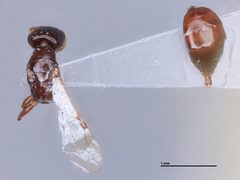
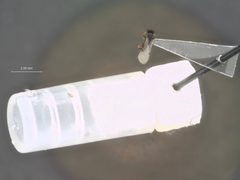
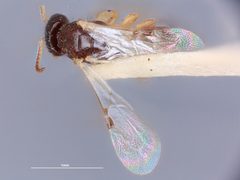
3Goniozus is a of parasitic in the Bethylidae, with at least 20 described . Species in this genus are ectoparasitoids of concealed lepidopteran larvae, with some species also associated with insect-induced plant galls. Several species have been evaluated or deployed as agents against agricultural pests, including G. legneri for grapevine control in Argentina and G. omanensis for lesser date moth management in Oman. The genus exhibits parental care , with females guarding progeny until cocoon formation.
Pronunciation
How to pronounce Goniozus: //ɡoʊˈniːoʊzəs//
These audio files are automatically generated. While they are not always 100% accurate, they are a good starting point.
Images
Habitat
Agricultural and natural environments where concealed lepidopteran occur; includes vineyards, date palm orchards, walnut orchards, and areas with insect-induced plant galls. occupy concealed microhabitats such as host feeding galleries within fruits, clusters, or galls.
Distribution
Widespread distribution with records from Argentina, Oman, India, and Europe (Denmark, Norway, Sweden). Individual show more restricted ranges: G. legneri native to Mendoza province, Argentina; G. omanensis in Oman and neighboring Gulf states; G. inauditus and G. kuriani described from South India.
Diet
Ectoparasitoid of concealed lepidopteran larvae; fifth instar larvae commonly parasitized. Some attack non-lepidopteran in concealed within insect-induced plant galls.
Host Associations
- Lobesia botrana - Grapevine ; attacked by G. legneri in Argentine vineyards
- Ectomyelois ceratoniae - Attacked on walnut and Vachellia caven
- Cydia pomonella - Codling moth; attacked on walnut
- Plodia interpunctella - Preferred over C. pomonella and L. botrana in choice tests
- Batrachedra amydraula - Lesser date ; primary of G. omanensis
- Opisina arenosella - Coconut black-headed caterpillar; G. nephantidis evaluated for control
Life Cycle
Development from to approximately 15 days at 25°C in G. legneri. Preimaginal survival varies by quality; 25% survival reported on L. botrana. Parental care involves females guarding progeny until cocoon formation, which extends development time and reduces reproductive output.
Behavior
Exhibits parental care: females remain with and guard developing progeny until cocoon formation. location mediated by olfactory cues, specifically responding to volatiles from host , silk, and damaged plant material. Can discriminate host quality and shows preference hierarchies among potential hosts. Multiparasitism responses observed when encountering hosts previously parasitized by competing endoparasitoids.
Ecological Role
agent for concealed-feeding lepidopteran pests. Functions as an ectoparasitoid in natural enemy , potentially competing with endoparasitoids through multiparasitism. Semi-field releases of G. legneri achieved approximately 50% reduction in pest at 1:1 : ratio during specific phenological windows.
Human Relevance
Evaluated and deployed for of agricultural pests. G. legneri investigated for grapevine management in Argentine vineyards; G. omanensis released in date palm orchards in Oman, with single releases achieving 80% pest control; G. nephantidis evaluated for coconut black-headed caterpillar control in India. Effectiveness varies by quality and release strategy.
Similar Taxa
- Bracon hebetorBoth evaluated as agents against lepidopteran pests and used in inundative release programs; Bracon is endoparasitoid while Goniozus is ectoparasitoid with parental care
- Dolichogenidea tasmanicaEndoparasitoid competitor within same ; Goniozus exhibits multiparasitism responses when encountering hosts containing this
More Details
Reproductive biology
G. legneri (rm) = 0.09 when parental care is prevented, dropping to 0.05 when parental care is permitted. First oviposition by inexperienced females averages 9.1 per larva; continuous oviposition yields 3.76 eggs per larva; oviposition following parental care period yields 7.30 eggs per larva.
Host location specificity
G. legneri orients to olfactory cues from grape clusters specifically at the green berry phenological stage, showing significant residence time on damaged clusters (75-84 seconds) versus clean air controls (35-46 seconds). Cannot effectively locate at other phenological stages, limiting natural control potential.
Taxonomic expansion
Two new Indian (G. inauditus, G. kuriani) described from insect-induced plant galls, representing range extension beyond Lepidoptera to non-lepidopteran gall inhabitants in concealed .
Sources and further reading
- BugGuide
- Wikipedia
- GBIF taxonomy match
- iNaturalist taxon
- NCBI Taxonomy
- Evaluación del parasitoide nativo Goniozus legneri (Hymenoptera: Bethylidae) para el control biológico aumentativo de la polilla de la vid Lobesia botrana (Lepidoptera: Tortricidae)
- Don't Judge a ‘Bug’ by its Cover: Multiparasitism Responses of the Ectoparasitoid Goniozus Jacintae to Hosts Containing the Endoparasitoid Dolichogenidea Tasmanica
- Biological Control of Lesser Date Moth (Batrachedra. Amydraula/ mayrick) using the local parasitoid Goniozus omanensis المكافحة الحيوية لآفة الحميرة (Batrachedra. Amydraula/ mayrick) باستخدام الطفيل المحلي طفيل الجينوزس Goniozus omanensis
- Impact of Inundative Releases of Parasitoids (Bracon hebetor and Goniozus nephantidis) against Coconut Black Headed Caterpillar under Severe Infestations
- Oviposition Behavior and Development of Goniozus triangulifer Kieffer (Hymenoptera: Bethylidae)
- Descriptions of two new Species of Goniozus Förster, 1856 (Hymenoptera: Bethylidae) associated with insect induced plant galls from India