
Lobesia botrana
(Denis & Schiffermüller, 1775)
European grapevine moth, European grape worm
Lobesia botrana is a tortricid native to Southern Italy, now distributed across Southern Europe, North Africa, Anatolia, the Caucasus, and introduced to Japan, Chile, Argentina, and briefly California (2009–2016). It is a major vineyard pest whose larvae feed internally on grape berries, causing direct damage and facilitating secondary fungal . The has two to three per year in Europe, with pupae in silken cocoons.
Pronunciation
How to pronounce Lobesia botrana: /loˈbe.si.a bɔˈtra.na/
These audio files are automatically generated. While they are not always 100% accurate, they are a good starting point.
Identification
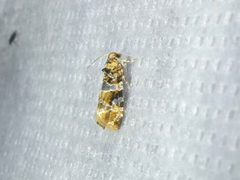
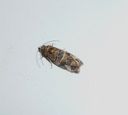
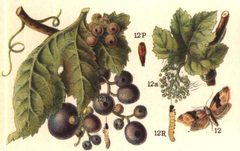
are small with forewings mottled in tan-brown, greyish, and dark-brown blotches; hindwings are gray with fringed borders. Females are slightly larger than males. Body length 6–8 mm, wingspan 12–13 mm. Larvae are 8–9 mm long, yellowish green to light brown with a light yellow .
Images
Habitat
Vineyards and areas supporting wild or cultivated grapevines (Vitis vinifera); also found on spurge laurel (Daphne gnidium) and other plants in suitable climates.
Distribution
Native to Southern Italy. Native range includes Southern Europe, North Africa, Anatolia, and the Caucasus. Introduced to Japan, Chile, and Argentina; eradicated from California (USA) in 2016 after detection in 2009.
Seasonality
Two to three per year in Europe; active during growing season. Pupae overwinter in silken cocoons.
Diet
Larvae feed primarily on flowers and fruit of grape (Vitis vinifera) and spurge laurel (Daphne gnidium). Additional recorded include blackberry (Rubus fruticosus), currants (Ribes sp.), olive (Olea europaea), cherry (Prunus avium), plum (Prunus domestica), kiwifruit (Actinidia chinensis), and pomegranate (Punica granatum).
Host Associations
- Vitis vinifera - primary main ; larvae feed on flowers and fruit causing major economic damage
- Daphne gnidium - primary significant alternative ; larval development faster and pupae heavier than on grapevine in some conditions
- Olea europaea - secondary larvae can complete development on olive inflorescences; multiplication rates comparable or higher than on grapevine
- Rubus fruticosus - secondary recorded plant
- Ribes sp. - secondary recorded plant
- Prunus avium - secondary recorded plant
- Prunus domestica - secondary recorded plant
- Actinidia chinensis - secondary recorded plant
- Punica granatum - secondary recorded plant
Life Cycle
hatch into larvae that develop in 20–30 days. Larvae feed on plant reproductive structures, then pupate. Pupae overwinter inside silken cocoons. Two to three per year in Europe.
Behavior
Female oviposition preference is influenced by plant volatiles; vine inflorescences preferred over olive inflorescences in two-choice tests. Larvae tunnel into berries and feed internally, leaving excrement. occurs in protected locations.
Ecological Role
Herbivore and fruit pest; larval feeding creates entry points for fungal including Botrytis cinerea. Serves as for including Campoplex capitator, Goniozus legneri, and Trichogramma cacoeciae.
Human Relevance
Major economic pest of vineyards worldwide. Larvae damage grapes directly and facilitate secondary rot, reducing yield and quality. Subject to efforts in California (successful 2016) and ongoing management elsewhere through , , , and cultural practices such as bunch-zone leaf removal.
Similar Taxa
- Other Tortricidae grape pestsSimilar size and ; distinguished by forewing pattern and larval coloration
- Ectomyelois ceratoniaeCo-occurs in some regions; different range and larval
Sources and further reading
- BugGuide
- Wikipedia
- GBIF taxonomy match
- iNaturalist taxon
- NCBI Taxonomy
- Catalogue of Life
- Bugs for All, All for Bugs | Bug Squad
- A True Success Story | Bug Squad
- European grapevine moth - Lobesia botrana (pinned) - Entomology Today
- European grapevine moth - Lobesia botrana - Entomology Today
- The Mechanism Matters: How Leaf Removal Kills a Common Grape Pest
- An Invasive-Species Success Story: The Eradication of the European Grapevine Moth in California
- Lobesia botrana . [Distribution map].
- Lobesia botrana . [Distribution map].
- Chemical Ecology and Management of Lobesia botrana (Lepidoptera: Tortricidae)
- Physiological factors regulating polyandry in Lobesia botrana (Lepidoptera: Tortricidae)
- Figure 4 from: Loni A, Samartsev KG, Scaramozzino PL, Belokobylskij SA, Lucchi A (2016) Braconinae parasitoids (Hymenoptera, Braconidae) emerged from larvae of Lobesia botrana (Denis & Schiffermüller) (Lepidoptera, Tortricidae) feeding on Daphne gnidium L. ZooKeys 587: 125-150. https://doi.org/10.3897/zookeys.587.8478
- Lobesia botrana as a preferred host of Campoplex capitator, the most occurring larval parasitoid in European vineyards
- Perception of host plant volatiles contributes to an optimised strategy for reproduction in the European grapevine moth, Lobesia botrana
- Host plants of the polyphagous grapevine moth Lobesia botrana during larval stage modulate moth egg quality and subsequent parasitism by the parasitoid Trichogramma cacoeciae
- Evaluación del parasitoide nativo Goniozus legneri (Hymenoptera: Bethylidae) para el control biológico aumentativo de la polilla de la vid Lobesia botrana (Lepidoptera: Tortricidae)
- Plant and microbial volatiles as potential behaviour modifying chemicals for the grapevine moth, Lobesia botrana
- Development and reproduction of Lobesia botrana on vine and olive inflorescences
- Biology of Lobesia botrana and its control methods in the conditions of the Southern Dagestan
- Relative performance of European grapevine moth (Lobesia botrana) on grapes and other hosts
- RNA virus discovery sheds light on the virome of a major vineyard pest, the European grapevine moth ( Lobesia botrana )