
Lobesia
Guenée, 1845
Species Guides
2- Lobesia botrana(European grapevine moth)
- Lobesia spiraeae
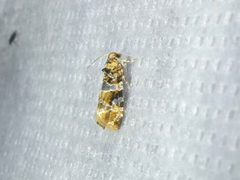
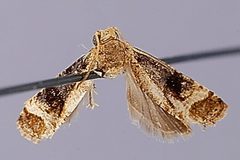
Lobesia is a of tortricid moths in the Olethreutinae. The genus includes several , with Lobesia botrana (European grapevine moth) being the most economically significant and well-studied. Species in this genus are primarily associated with feeding on grapevines and related plants, with larvae causing damage to fruits and inflorescences. Some species have been documented as pests in viticulture regions outside their native ranges.

Pronunciation
How to pronounce Lobesia: //loʊˈbiːziə//
These audio files are automatically generated. While they are not always 100% accurate, they are a good starting point.
Images
Habitat
Vineyards and areas with plants in the Vitaceae, Thymelaeaceae, and Ranunculaceae. Some utilize wild host plants including Daphne gnidium and Clematis species in natural and semi-natural .
Distribution
Native to Europe, with introductions to North America (California, eradicated 2016), South America (Argentina, Chile), and parts of Africa and the Middle East. Present across Mediterranean regions, Central Asia, and extending to parts of northern Europe.
Diet
Larvae feed on developing fruits and inflorescences. Documented plants include Vitis vinifera (grapevine), Daphne gnidium (spurge flax), Clematis , and Olea europaea (olive). during larval stage with host plant quality affecting subsequent development.
Host Associations
- Vitis vinifera - larval food plantprimary ; fruits and inflorescences consumed
- Daphne gnidium - larval food plantwild plant in natural
- Clematis - larval food plantalternative
- Olea europaea - larval food plantolive inflorescences support faster larval development than grapevine in some conditions
- Goniozus legneri - native in Argentina; low quality relationship
- Campoplex capitator - most common larval in European vineyards
- Trichogramma cacoeciae - ; plant of larval stage affects rates
- Bracon admotus - idiobiont ectoparasitoid from Braconinae
- Habrobracon concolorans - idiobiont ectoparasitoid
- Habrobracon hebetor - idiobiont ectoparasitoid
- Habrobracon pillerianae - idiobiont ectoparasitoid; new record for Western Europe
Life Cycle
Complete with , larval, pupal, and stages. Larval development rate varies with plant and temperature. On olive inflorescences, larval development is significantly faster than on grapevine inflorescences of similar developmental stage. Pupae may be heavier on olive than on vine hosts. Multiple per year in favorable climates.
Behavior
Female utilize plant volatiles for oviposition decisions. In laboratory two-choice tests, vine inflorescences are preferred over olive inflorescences and leaves for oviposition. Larvae feed within grape clusters, creating silk webbing. techniques have been employed as a management strategy. Larvae demonstrate susceptibility to high temperatures and low humidity, with significant mortality of at 40°C and 60% relative humidity, and of newly hatched larvae at 37°C.
Ecological Role
Herbivore; larval feeding on fruits and inflorescences. Serves as for multiple in Braconidae, Bethylidae, and Ichneumonidae. Larval feeding damage can facilitate secondary fungal , particularly Botrytis cinerea.
Human Relevance
Major pest of viticulture causing direct damage to grape yields and indirect losses through fungal entry. Subject to successful program in California (2009-2016) using integrated approach including , , regulations, and extensive monitoring. Management strategies include bunch-zone leaf removal, which increases larval and mortality through elevated temperatures and reduced humidity. programs have evaluated native and introduced with varying success.
Similar Taxa
- Cydia pomonellaBoth are tortricid pests of fruit crops with similar larval feeding habits; distinguished by plant association and morphological characters
- Ectomyelois ceratoniaeOverlapping distribution and shared (e.g., Goniozus legneri); distinguished by plant range and larval
More Details
Invasion biology
Lobesia botrana spread in California was facilitated by human-aided transport along transportation corridors, with clustered in 'hot spots' larger than the 's natural range. success attributed to early detection, rapid response, and extensive data gathering on occurrence and abundance.
Climate sensitivity
Microclimate modification through agricultural practices (bunch-zone leaf removal) can significantly reduce by exposing and larvae to lethal temperatures. Climate warming may reduce in some regions but potentially shift distribution northward.
Host plant quality effects
Larval plant affects subsequent : females reared on olive produce more and higher multiplication rates than those reared on grapevine, despite oviposition preference for grapevine.
Sources and further reading
- BugGuide
- Wikipedia
- GBIF taxonomy match
- iNaturalist taxon
- NCBI Taxonomy
- Catalogue of Life
- Bugs for All, All for Bugs | Bug Squad
- A True Success Story | Bug Squad
- European grapevine moth - Lobesia botrana (pinned) - Entomology Today
- European grapevine moth - Lobesia botrana - Entomology Today
- The Mechanism Matters: How Leaf Removal Kills a Common Grape Pest
- An Invasive-Species Success Story: The Eradication of the European Grapevine Moth in California
- Lobesia botrana . [Distribution map].
- Lobesia botrana . [Distribution map].
- Figure 4 from: Loni A, Samartsev KG, Scaramozzino PL, Belokobylskij SA, Lucchi A (2016) Braconinae parasitoids (Hymenoptera, Braconidae) emerged from larvae of Lobesia botrana (Denis & Schiffermüller) (Lepidoptera, Tortricidae) feeding on Daphne gnidium L. ZooKeys 587: 125-150. https://doi.org/10.3897/zookeys.587.8478
- Host plants of the polyphagous grapevine moth Lobesia botrana during larval stage modulate moth egg quality and subsequent parasitism by the parasitoid Trichogramma cacoeciae
- Lobesia botrana as a preferred host of Campoplex capitator, the most occurring larval parasitoid in European vineyards
- Perception of host plant volatiles contributes to an optimised strategy for reproduction in the European grapevine moth, Lobesia botrana
- Evaluación del parasitoide nativo Goniozus legneri (Hymenoptera: Bethylidae) para el control biológico aumentativo de la polilla de la vid Lobesia botrana (Lepidoptera: Tortricidae)
- Plant and microbial volatiles as potential behaviour modifying chemicals for the grapevine moth, Lobesia botrana
- New Host-plants of <I>Lobesia</I> (<I>Lobesia</I>) <I>aeolopa</I> MEYRICK
- Development and reproduction of Lobesia botrana on vine and olive inflorescences
- Biology of Lobesia botrana and its control methods in the conditions of the Southern Dagestan