
Campoplex
Gravenhorst, 1829
Species Guides
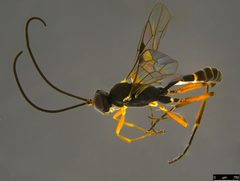
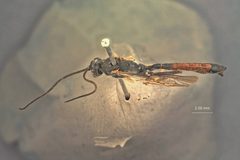
1Campoplex is a of ichneumonid parasitic in the tribe Campoplegini. are larval endoparasitoids with narrow ranges, primarily targeting lepidopteran pests. Several species have been investigated for of agricultural pests, particularly in vineyards. The genus is taxonomically challenging, with species historically difficult to distinguish due to inadequate descriptions.

Pronunciation
How to pronounce Campoplex: /ˈkæmpəˌplɛks/
These audio files are automatically generated. While they are not always 100% accurate, they are a good starting point.
Identification
within Campoplex are difficult to distinguish and require detailed examination of morphological characters. The Campoplex difformis group has been revised with updated illustrations for identification. Key species include C. difformis, C. capitator, C. dubitator, C. formosanae, and C. unicingulatus. A lectotype has been designated for C. capitator to stabilize .
Images
Distribution
Europe (including Denmark, Norway, Sweden); Qinghai province, China. Specific distribution varies by .
Host Associations
- Lobesia botrana - larval Preferred of C. capitator; tortricid grapevine pest
- Eupoecilia ambiguella - larval Alternative of C. capitator in European vineyards
- Bazaria turensis - larval of C. bazariae; Pyralidae
- Ancylis mitterbacheriana - larval record for C. capitator queried in revision
Life Cycle
Solitary endoparasitoid of larval stage. Development occurs within larvae.
Behavior
Males of C. capitator perform wing-fanning at high frequencies during courtship to approach females successfully. Antennal tapping of the female body follows wing-fanning before copulation attempts. -level behavioral asymmetries occur: wing-fanning is left-lateralized while antennal tapping is right-biased. Mating success exceeds 70% with copulation duration averaging approximately 255 seconds. Naïve females show distinct preference, preferentially seeking Lobesia botrana over Eupoecilia ambiguella.
Ecological Role
Natural enemy of lepidopteran pest in agricultural systems. Major larval in European vineyards. Investigated as agent for tortricid grapevine and other crop pests.
Human Relevance
Evaluated for biocontrol of Lobesia botrana and other grapevine pests. Mass-rearing protocols under development for C. capitator. Male wing-fanning frequency proposed as benchmark for monitoring mate quality in captive .
Similar Taxa
More Details
Taxonomic challenges
Previous works provided short descriptions or poor illustrations of crucial characters, making identification difficult. Recent revisions have provided redescriptions and illustrations to improve identification .
Nomenclatural acts
Lectotype designated for C. capitator in Aubert's collection, Lausanne. Campoplex corsicator removed from synonymy with C. tibialis and elevated to status (stat. nov.).
Sources and further reading
- BugGuide
- Wikipedia
- GBIF taxonomy match
- iNaturalist taxon
- NCBI Taxonomy
- Catalogue of Life
- Lobesia botrana as a preferred host of Campoplex capitator, the most occurring larval parasitoid in European vineyards
- Figures 11–12 from: Zhao Y-X, Sheng M-L (2014) A new parasitoid of Bazaria turensis (Lepidoptera, Pyralidae): Campoplex bazariae sp. n. (Hymenoptera, Ichneumonidae). ZooKeys 466: 43-51. https://doi.org/10.3897/zookeys.466.8618
- Figures 1–5 from: Zhao Y-X, Sheng M-L (2014) A new parasitoid of Bazaria turensis (Lepidoptera, Pyralidae): Campoplex bazariae sp. n. (Hymenoptera, Ichneumonidae). ZooKeys 466: 43-51. https://doi.org/10.3897/zookeys.466.8618
- Figures 6–10 from: Zhao Y-X, Sheng M-L (2014) A new parasitoid of Bazaria turensis (Lepidoptera, Pyralidae): Campoplex bazariae sp. n. (Hymenoptera, Ichneumonidae). ZooKeys 466: 43-51. https://doi.org/10.3897/zookeys.466.8618
- A new parasitoid of Bazaria turensis (Lepidoptera, Pyralidae): Campoplex bazariae sp. n. (Hymenoptera, Ichneumonidae)
- Taxonomic revision of the Campoplex difformis group (Ichneumonidae, Campopleginae), with particular reference to species of economic importance
- The Biology of Campoplex haywardi (Hymenoptera: Ichneumonidae), A Primary Parasite of the Potato Tuberworm1
- Foraging Behaviour and Patch Exploitation by Campoplex dubitator (Hymenoptera: Ichneumonidae), a Parasitoid of Bark-mining Larvae
- Wing‐fanning frequency as a releaser boosting male mating success—High‐speed video analysis of courtship behavior in Campoplex capitator, a parasitoid of Lobesia botrana