
Dusona
Cameron, 1901
Species Guides
4Dusona is a large of in the Ichneumonidae, Campopleginae, with 442 described . It is the most species-rich genus in its subfamily and has a distribution. Members are morphologically distinctive within Campopleginae and primarily parasitize Lepidopteran larvae.
Pronunciation
How to pronounce Dusona: //duːˈsoʊ.nə//
These audio files are automatically generated. While they are not always 100% accurate, they are a good starting point.
Identification
Distinguished from other Campopleginae by the combination of: elongated oval or slit-shaped propodeal ; strongly compressed metasoma; closed areolets; and petiolar that are obliterated or positioned very low anteriorly. Many reach unusually large body sizes compared to other campoplegines. Species-level identification requires detailed examination and reference to specialized keys.
Images
Appearance
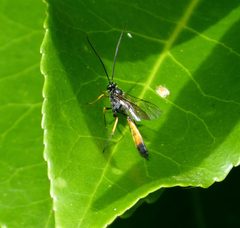
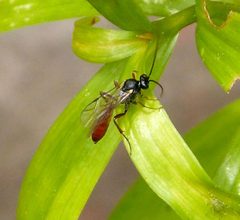
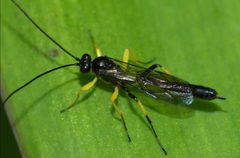
Medium to large-bodied ichneumonid wasps, with some exceeding 20 mm. Diagnostic features include elongated, oval or slit-shaped propodeal ; strongly compressed metasoma; closed areolets in wing venation; and petiolar that are often obliterated or positioned very low anteriorly. and typically uniformly black; variable in coloration including black, red, brown, orange, and yellow, with first and outermost tergites most commonly black.
Distribution
. Documented from Sweden, Switzerland, Iran (Fars, Kerman, Mazandaran, Golestan, West Azerbaijan provinces), Denmark, Norway, and additional global localities. Western Palaearctic fauna particularly well-documented with 125 .
Seasonality
periods indicate both and patterns among ; specific timing varies by species and geography.
Host Associations
- Lepidoptera - Main are larvae of Lepidopterans; host typically killed as , occasionally as pupa
- Monoctenus juniperi - Only known non-lepidopteran ; reported for Dusona minor, a (Hymenoptera: )
Life Cycle
development; killed as in most , rarely as pupa. Voltinism varies: five species documented as , others as based on period data.
Ecological Role
of Lepidopteran larvae, contributing to of and . One documented exception parasitizes a species.
Similar Taxa
- Other Campopleginae generaDusona distinguished by diagnostic combination of propodeal shape, metasomal compression, areolet structure, and petiolar position; many Dusona also notably larger-bodied
More Details
Species richness
With 442 described , Dusona is the most species-rich in Campopleginae and among the most diverse genera of Darwin wasps (Ichneumonidae).
Molecular identification challenges
has limitations for this : several morphologically distinct show barely discriminatory COI barcode sequences (p-distances < 2%) or paraphyly, indicating that barcodes alone are insufficient for species identification in Dusona.
Taxonomic accessibility
Recent photographic guides to diagnostic characters and detailed plates have been developed for Western Palaearctic species to facilitate identification by non-.
Sources and further reading
- BugGuide
- Wikipedia
- GBIF taxonomy match
- iNaturalist taxon
- NCBI Taxonomy
- Catalogue of Life
- Casinaria Holmgren and Dusona Cameron (Hymenoptera: Ichneumonidae) in Iran: distribution extension
- Open access in a taxonomic sense: a morphological and molecular guide to Western Palaearctic Dusona (Hymenoptera, Ichneumonidae)