
Choreutidae
metalmark moths
Subfamily Guides
1- Choreutinae(metalmark moths)
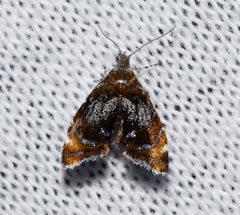
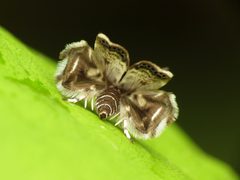
, commonly known as metalmark moths, are a of small Lepidoptera now placed in their own superfamily Choreutoidea. The family contains approximately 19 in three (Choreutinae, Brenthiinae, and possibly others), defined primarily by structural characteristics of larvae and pupae rather than . Many exhibit metallic scaling and distinctive , with some members of the genus Brenthia demonstrating documented mimicry of jumping spiders. The family has been subject to considerable taxonomic revision, having previously been placed in Yponomeutoidea and .
Pronunciation
How to pronounce Choreutidae: //kɔˌreɪˈjuːtɪdiː//
These audio files are automatically generated. While they are not always 100% accurate, they are a good starting point.
Identification
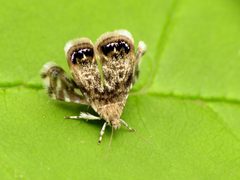
Distinguished from other small Lepidoptera by combination of small size, often metallic coloration, and habits. Choreutinae versus Brenthiinae separation relies on wing shape (pointed vs. obtuse), antennal scaling, and labial palpus structure. Some Brenthia identifiable by eyespot patterns that function in jumping spider mimicry. Larvae construct silken webbing on leaves and create characteristic escape holes along leaf .
Images
Appearance
Small , typically with wingspans under 20 mm. Many bear metallic , particularly in tropical such as Saptha which display bright green metallic bands. Wings often bluntly pointed in Choreutinae; Brenthiinae species possess obtuse wing tips. with heavily scaled basal flagellomeres in Choreutinae (absent in Brenthiinae). Labial palpus with parallel-sided basal segment in Choreutinae (narrowed basally in Brenthiinae). Some Brenthia species possess conspicuous eyespots on wings.
Habitat
Diverse worldwide; larvae associated with plants including figs (Ficus), nettles (Urtica), apple (Malus), and various woody and herbaceous plants. Urban areas support introduced such as Choreutis sexfasciella on ornamental Ficus. Tropical forest habitats contain spectacular metallic species such as Saptha.
Distribution
Worldwide distribution. Native in all major biogeographic regions. Several expanding ranges recently: Choreutis nemorana spreading from Mediterranean region northwards and eastwards into Central Europe since approximately 2006; Choreutis sexfasciella expanding throughout Mediterranean and into North America within last five years. Documented from Europe, Asia, Africa, Australasia, North America, and Pacific islands including Nicobar Islands.
Seasonality
active year-round in tropical regions; temperate active during warmer months. common; some species also attracted to lights.
Diet
Larvae skeletonize leaves of plants, feeding among silken webbing. Documented host plant include Asteraceae, Betulaceae, Boraginaceae, Dipterocarpaceae, Fabaceae, Lamiaceae, Malvaceae, Moraceae (primarily Ficus), Rosaceae, Sapindaceae, and Urticaceae. Specific associations: Anthophila fabriciana on Urtica (stinging nettles); Choreutis pariana on Malus (apple); Choreutis tigroides on Artocarpus (jackfruit); Choreutis nemorana and C. sexfasciella on Ficus ; Brenthia yangi on Grewia biloba (Malvaceae).
Host Associations
- Ficus - larval Multiple Choreutis including C. nemorana, C. sexfasciella, C. tigroides
- Urtica - larval Anthophila fabriciana
- Malus - larval Choreutis pariana
- Artocarpus - larval Choreutis tigroides
- Grewia biloba - larval Brenthia yangi
- Olearia lyalli - larval Asterivora oleariae
Life Cycle
Holometabolous. Larvae pass through five instars (documented in Brenthia yangi). Early instars (I–II) show no significant preference for escape hole position; later instars (III–V) preferentially construct escape holes along main leaf , with silken pillar size determining hole position. occurs within silken webbing or cocoons on plants or ground.
Behavior
Primarily with jerky, pivoting . may fluff wings at extreme angles when at rest. Documented mimicry: Brenthia display wing patterns resembling jumping spider (, , front legs) to deter ; this was formally described in 2006. Larvae construct silken webbing and feeding shelters on leaves.
Ecological Role
Herbivores as larvae, skeletonizing leaves and potentially causing economic damage to fig and other crops. Serve as for diverse including Ichneumonidae (Oiorhinus pallipalpis, Scambus inanis, Scambus elegans, Encrateola laevigata, Mesochorus vittator, Diadegma ) and Eulophidae (Elasmus). One species (Encrateola laevigata) acts as facultative pseudohyperparasitoid; Mesochorus vittator is a true hyperparasitoid.
Human Relevance
Some are economic pests: Choreutis nemorana threatens fig in expanding European range; Choreutis tigroides is a documented pest of jackfruit; Choreutis sexfasciella damages ornamental Ficus in urban areas. No licensed available for some . Local show potential for . Anthophila fabriciana is a familiar, conspicuous species around nettles in Europe.
Similar Taxa
- GlyphipterigidaePreviously classified together; distinguished by different larval and structural characters
- Sesiidae (clearwing moths)Formerly placed in same superfamily ; lack transparent wings and -mimicry of sesiids
- Yponomeutidae (ermine moths)Previously classified in Yponomeutoidea; differ in larval webbing and
More Details
Taxonomic history
placement long disputed. Previously assigned to Yponomeutoidea (as family Glyphipterigidae) and to . Now recognized as superfamily Choreutoidea (Minet, 1986). Relationships to other Apoditrysia lineages require reassessment with molecular data.
Subfamily classification
Three defined by structural characteristics of stages (larvae and pupae): Choreutinae, Brenthiinae, and possibly others. characters alone insufficient for subfamily placement.
Invasive spread
Multiple showing rapid range expansion: Choreutis nemorana from Mediterranean to Central Europe since 2006; Choreutis sexfasciella throughout Mediterranean and North America within five years. confirms identity of expanding .
Sources and further reading
- BugGuide
- Wikipedia
- GBIF taxonomy match
- iNaturalist taxon
- NCBI Taxonomy
- Catalogue of Life
- Bug Eric: A Case of Predator Mimicry in the Bee Fly Genus Epacmus? (Diptera: Bombyliidae)
- Choreutis nemorana (Hübner, 1799) (Lepidoptera: Choreutidae) in Serbia
- "Others": Anomoeotidae, Bucculatricidae, Choreutidae, Cossidae, Drepanidae, Galacticidae, Gracillariidae, Hyblaeidae, Lacturidae, Limacodidae, Plutellidae
- Brenthia yangi sp. nov. and its immature stages (Lepidoptera: Choreutidae: Brenthiinae)
- A new genus and new species of metalmark moths (Lepidoptera: Choreutidae) from Costa Rica
- A new genus of metalmark moths (Lepidoptera, Choreutidae) with Afrotropical and Australasian distribution
- Historical collections continue to support faunistic research: the first record of Saptha divitiosa (Lepidoptera, Choreutidae) from the Nicobar Islands, India
- Figure 12 from: Rota J, Miller S (2013) A new genus of metalmark moths (Lepidoptera, Choreutidae) with Afrotropical and Australasian distribution. ZooKeys 355: 29-47. https://doi.org/10.3897/zookeys.355.6158
- A new generic name for the New Zealand species previously assigned to Simaethis auctorum (Lepidoptera: Choreutidae), with description of a new species
- New ichneumonid (Hymenoptera) parasitoids of the fig-tree skeletoniser moth, Choreutis nemorana (Hubner, 1799) (Lepidoptera, Choreutidae), an invasive pest to Central Europe
- DNA barcoding reveals the first record of the Banyan Leaf Skeletonizer Moth, Choreutis sexfasciella (Sauber, 1902) (Lepidoptera, Choreutidae), in Greece
- Anatomy, reach and classification of the parasitoid complex of a common British moth,Anthophila fabriciana(L.) (Choreutidae)
- A cosmopolitan invader – Choreutis sexfasciella (Lepidoptera, Choreutidae) – in Cyprus: first record, molecular characterization, and a reared parasitoid
- A New Genus of Rhysipoline Wasp (Hymenoptera: Braconidae) with Modified Wing Venation from Africa and Papua New Guinea, Parasitoid on Choreutidae (Lepidoptera)