
Choreutis
Hübner, 1825
Species Guides
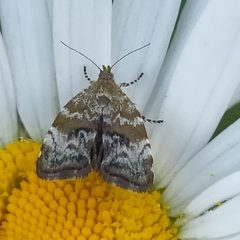
3- Choreutis diana(Diana's choreutis moth)
- Choreutis pariana(apple leaf skeletonizer moth)
- Choreutis sexfasciella(Banyan Leaf Skeletonizer Moth)
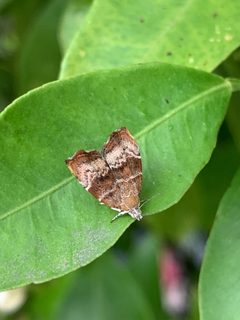
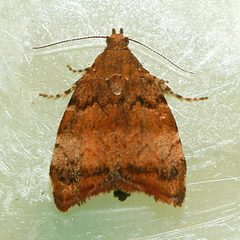
Choreutis is a of metalmark moths in the Choreutidae, established by Jacob Hübner in 1825. It serves as the type genus for both the family Choreutidae and Choreutinae. Several within this genus, particularly Choreutis nemorana (fig-tree skeletonizer) and Choreutis sexfasciella (Banyan Leaf Skeletonizer), have become notable as pests of Ficus species, with documented range expansions into Central and Eastern Europe and the Mediterranean region.
Pronunciation
How to pronounce Choreutis: //koʊˈruːˌtɪs//
These audio files are automatically generated. While they are not always 100% accurate, they are a good starting point.
Images
Habitat
Associated with Ficus plants; some occur in urban areas where ornamental fig trees are cultivated.
Distribution
Widespread distribution with records from Europe (including Denmark, Norway, Sweden, Austria, Belgium, British Isles, Hungary, Slovakia, Bulgaria, Serbia, Greece, Cyprus), North America (Vermont, USA), and the Mediterranean region. Specific show expanding ranges: C. nemorana spreading northwards and eastwards from Mediterranean origins, C. sexfasciella expanding from Philippine origins into Mediterranean countries and North America.
Host Associations
- Ficus - larval plantMultiple Ficus including F. microcarpa, F. benjamina, and cultivated figs
Ecological Role
Some function as non-native pests affecting fig ; local have been observed to adopt these introduced species as , including ichneumonid wasps (Oiorhinus pallipalpis, Scambus inanis, Scambus elegans, Encrateola laevigata) and eulophid (Elasmus cf. cyprianus).
Human Relevance
Several are economically significant pests of fig . Choreutis nemorana threatens fig production in expanding areas of Central and Eastern Europe where licensed are lacking. Choreutis sexfasciella affects ornamental Ficus trees in urban environments. Both species have documented socioeconomic impacts and are subjects of research.
More Details
Taxonomic status
Type of Choreutidae and Choreutinae
Molecular research
has been used to confirm identity and track range expansions, particularly for C. sexfasciella in newly colonized regions
Parasitoid research
Studies in Hungary documented parasitization rates of C. nemorana ranging from 9.4% to 52.6%, with multiple ichneumonid and one hyperparasitoid (Mesochorus vittator) reared from larvae and cocoons
Sources and further reading
- BugGuide
- Wikipedia
- GBIF taxonomy match
- iNaturalist taxon
- NCBI Taxonomy
- Catalogue of Life
- Choreutis nemorana (Hübner, 1799) (Lepidoptera: Choreutidae) in Serbia
- A cosmopolitan invader – Choreutis sexfasciella (Lepidoptera, Choreutidae) – in Cyprus: first record, molecular characterization, and a reared parasitoid
- DNA barcoding reveals the first record of the Banyan Leaf Skeletonizer Moth, Choreutis sexfasciella (Sauber, 1902) (Lepidoptera, Choreutidae), in Greece
- Fig 2 from: Demetriou J, Aristophanous M, Koutsoukos E, John E, Roy HE, Martinou AF, Rota J (2025) A cosmopolitan invader – Choreutis sexfasciella (Lepidoptera, Choreutidae) – in Cyprus: first record, molecular characterization, and a reared parasitoid. Nota Lepidopterologica 48: 15-28. https://doi.org/10.3897/nl.48.137778
- Fig 1 from: Demetriou J, Aristophanous M, Koutsoukos E, John E, Roy HE, Martinou AF, Rota J (2025) A cosmopolitan invader – Choreutis sexfasciella (Lepidoptera, Choreutidae) – in Cyprus: first record, molecular characterization, and a reared parasitoid. Nota Lepidopterologica 48: 15-28. https://doi.org/10.3897/nl.48.137778
- Fig 3 from: Demetriou J, Aristophanous M, Koutsoukos E, John E, Roy HE, Martinou AF, Rota J (2025) A cosmopolitan invader – Choreutis sexfasciella (Lepidoptera, Choreutidae) – in Cyprus: first record, molecular characterization, and a reared parasitoid. Nota Lepidopterologica 48: 15-28. https://doi.org/10.3897/nl.48.137778
- New ichneumonid (Hymenoptera) parasitoids of the fig-tree skeletoniser moth, Choreutis nemorana (Hubner, 1799) (Lepidoptera, Choreutidae), an invasive pest to Central Europe
- Fig 4 from: Demetriou J, Aristophanous M, Koutsoukos E, John E, Roy HE, Martinou AF, Rota J (2025) A cosmopolitan invader – Choreutis sexfasciella (Lepidoptera, Choreutidae) – in Cyprus: first record, molecular characterization, and a reared parasitoid. Nota Lepidopterologica 48: 15-28. https://doi.org/10.3897/nl.48.137778
- Fig 5 from: Demetriou J, Aristophanous M, Koutsoukos E, John E, Roy HE, Martinou AF, Rota J (2025) A cosmopolitan invader – Choreutis sexfasciella (Lepidoptera, Choreutidae) – in Cyprus: first record, molecular characterization, and a reared parasitoid. Nota Lepidopterologica 48: 15-28. https://doi.org/10.3897/nl.48.137778
- Supplementary material 1 from: Demetriou J, Aristophanous M, Koutsoukos E, John E, Roy HE, Martinou AF, Rota J (2025) A cosmopolitan invader – Choreutis sexfasciella (Lepidoptera, Choreutidae) – in Cyprus: first record, molecular characterization, and a reared parasitoid. Nota Lepidopterologica 48: 15-28. https://doi.org/10.3897/nl.48.137778
- Supplementary material 2 from: Demetriou J, Aristophanous M, Koutsoukos E, John E, Roy HE, Martinou AF, Rota J (2025) A cosmopolitan invader – Choreutis sexfasciella (Lepidoptera, Choreutidae) – in Cyprus: first record, molecular characterization, and a reared parasitoid. Nota Lepidopterologica 48: 15-28. https://doi.org/10.3897/nl.48.137778
- The genome sequence of the Fig-leaf Skeletoniser, Choreutis nemorana (Hübner, [1799]).