
Mesochorus
Gravenhorst, 1829
Species Guides
4Mesochorus is a large of ichneumonid wasps containing approximately 690-900 described worldwide. Members are obligate hyperparasitoids that attack the larvae of primary , typically ichneumonid or braconid wasps, and occasionally tachinid flies. These primary parasitoids are themselves endoparasitoids of larval Lepidoptera and Coleoptera, placing Mesochorus at the fourth in complex . The genus has been extensively studied in agricultural contexts due to its interactions with agents.
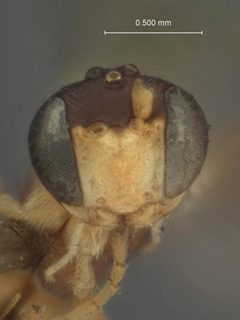
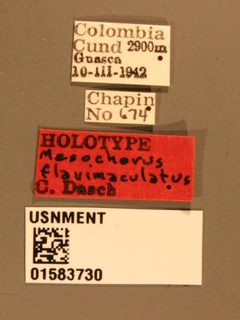
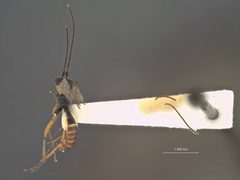
Pronunciation
How to pronounce Mesochorus: /mɛsˈoʊˌkɔrəs/
These audio files are automatically generated. While they are not always 100% accurate, they are a good starting point.
Images
Habitat
Occurs in diverse terrestrial including forests, agricultural systems, and grasslands. have been documented in alfalfa fields, oak woodlands, and tropical conservation areas. Presence is dictated by availability of complexes involving primary and their herbivorous hosts.
Distribution
Worldwide distribution with records from North America, Central America ( Rica), South America (Brazil), Europe (Denmark, Norway, Sweden), and Australia. The is particularly diverse in the Neotropics, with 158 new described from Área de Conservación Guanacaste, Costa Rica alone.
Host Associations
- ichneumonid wasps - hyperparasitoid primary ; larvae parasitized within lepidopteran hosts
- braconid wasps - hyperparasitoid primary ; includes Cotesia marginiventris and Peristenus spp.
- tachinid flies - hyperparasitoid occasional
- Lepidoptera larvae - indirect ultimate of primary ; includes Noctuidae such as Helicoverpa zea, Pseudoplusia includens, Spodoptera frugiperda, Plathypena scabra, and Phryganidia californica
- Coleoptera larvae - indirect ultimate of primary ; includes Hypera postica (alfalfa weevil)
- Hemiptera - indirect ultimate when primary (e.g., Peristenus spp.) attack plant bugs (Miridae)
Life Cycle
Females locate primary larvae or pupae developing within herbivore and oviposit directly into these secondary hosts. Development occurs entirely within the primary parasitoid, with the hyperparasitoid consuming the host from within. Specific developmental rates and stage requirements vary among ; some species show preferences for particular developmental stages of their primary parasitoid hosts.
Behavior
Females exhibit active -finding , capturing lepidopteran larvae to access primary within. Mesochorus discitergus shows variable success against host defensive tactics: caterpillars using vigorous responses are captured approximately 68% of the time, while those dropping on silken threads are captured 39% of the time, and those dropping unattached are captured roughly 26% of the time. Females use from primary parasitoids such as Cotesia marginiventris to locate suitable hosts.
Ecological Role
Functions as a fourth-trophic-level hyperparasitoid in complex , potentially disrupting of herbivorous pests by attacking their natural enemies. In agricultural systems, of Mesochorus may reduce the effectiveness of -based pest management. Conversely, they may contribute to of parasitoid and prevent hyperabundance of any single primary parasitoid .
Human Relevance
Significant relevance to programs, where hyperparasitism by Mesochorus can undermine pest management efforts targeting agricultural pests such as the alfalfa weevil and various noctuid caterpillars. The has been studied extensively to understand factors affecting capture and location, with implications for improving . Citizen science projects have contributed to discovery of new , including Mesochorus baccanellonyah described from a specimen collected by primary school students in South Australia.
Sources and further reading
- BugGuide
- Wikipedia
- GBIF taxonomy match
- iNaturalist taxon
- NCBI Taxonomy
- Catalogue of Life
- Bug Eric: Moth Monday: California Oak Moth
- Biology of Mesochorus nigripes:1 a Hyperparasite of Bathyplectes Spp.1,2
- Biology of Mesochorus agilis,1 an Indirect Hyperparasite of Bathyplectes cuculionis1,2
- Mesochorus baccanellonyah sp. nov.; a new species of parasitoid wasp from South Australia
- Behavioral Interactions Between the Hyperparasitoid Mesochorus discitergus (Hymenoptera: Ichneumonidae) and Four Species of Noctuid Caterpillars: Evasive Tactics and Capture Efficiency
- Real and potential distribution of the hyperparasitoid genus Mesochorus Gravenhorst (Ichneumonidae: Mesochorinae) in Brazil
- Hyperparasitism by Mesochorus spp. (Hymenoptera: Ichneumonidae) in Peristenus sp. (Hymenoptera: Braconidae) and development of PCR primers for hyperparasitoid detection
- Life History of the Hyperparasitoid Mesochorus discitergus (Hymenoptera: Ichneumonidae) and Tactics Used to Overcome the Defensive Behavior of the Green Cloverworm (Lepidoptera: Noctuidae)
- Developmental Stages and Kairomones from the Primary Parasitoid Cotesia marginiventris (Hymenoptera: Braeonidae) Affeet the Response of the Hyperparasitoid Mesochorus discitergus (Hymenoptera: Ichneumonidae) to Parasitized Caterpillars
- Biology, Host Preferences, and Abundance of <I>Mesochorus curvulus</I> (Hymenoptera: lchneumonidae), a Hyperparasite of <I>Peristenus</I> spp. (Hymenoptera: Braconidae) Parasitizing Plant Bugs (Miridae: Hemiptera) in Alfalfa-Grass Forage Crops
- Minimalist revision of Mesochorus Gravenhorst, 1829 (Hymenoptera: Ichneumonidae: Mesochorinae) from Área de Conservación Guanacaste, Costa Rica, with 158 new species and host records for 129 species