
Mesochorinae
Genus Guides
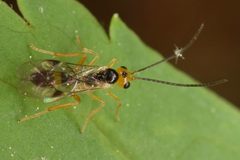
3Mesochorinae is a worldwide of ichneumonid wasps comprising 10 . Members are koinobiont hyperparasitoids, primarily attacking other parasitic (Ichneumonoidea) and, less frequently, tachinid flies. The genus Mesochorus is the most -rich, with hundreds of described species including recent large- descriptions from Rica. The subfamily occupies diverse biomes across multiple continents.
Pronunciation
How to pronounce Mesochorinae: //ˌmɛsəˈkɔːrɪniː//
These audio files are automatically generated. While they are not always 100% accurate, they are a good starting point.
Identification
Mesochorinae can be distinguished from other ichneumonid by their hyperparasitoid and associated morphological adaptations. The Mesochorus, which contains the majority of , is characterized by reduced wing venation and relatively small body size compared to many other ichneumonids. Accurate identification to species level typically requires examination of wing venation, structure, and in many cases .
Images
Habitat
Occurs across diverse terrestrial including Andean zones, Carpathian mountain systems, and Brazilian biomes (Amazon, Cerrado, Atlantic Forest, Caatinga, Pantanal, Pampa). The shows broad ecological , with individual often restricted to specific geographic regions.
Distribution
Worldwide distribution. Documented from Southern South America (Andean biogeographic zone), Ukrainian Carpathians, and multiple biomes throughout Brazil. The Mesochorus has been recorded across all major Brazilian biomes.
Host Associations
- Ichneumonoidea - hyperparasitoidprimary ; koinobiont endoparasitoids of ectoparasitic or endoparasitic
- Tachinidae - hyperparasitoidsecondary ; less frequently attacked than Ichneumonoidea
Life Cycle
Koinobiont endoparasitoid development. The larva develops inside a living primary , which itself is parasitizing a herbivore (typically a caterpillar). This creates a three-level trophic interaction.
Behavior
Hyperparasitism: females attack primary that are actively parasitizing herbivores. This places Mesochorinae at the tertiary in .
Ecological Role
Tertiary consumer in ; regulator of primary . Potential agent, though their hyperparasitoid habit can disrupt biological control programs targeting herbivorous pests.
Human Relevance
Potential use in , though their tendency to parasitize beneficial can be detrimental to pest management efforts. Large- taxonomic revisions (e.g., 158 new from Rica) demonstrate utility of for rapid biodiversity assessment in hyperdiverse tropical regions.
Similar Taxa
- other Ichneumonidae subfamiliesMesochorinae distinguished by hyperparasitoid versus primary in most other ; morphological convergence in wing reduction can complicate identification
More Details
Taxonomic diversity
The contains 10 : Artherola, Astiphromma, Chineater, Cidaphus, Latilumbus, Lepidura, Mesochorus, Planochorus, Thamester, and Varnado. Mesochorus is the most -rich genus with 46 species documented from the Ukrainian Carpathians alone and 158 new species described from a single Rican conservation area.
Detection methods
are frequently collected through rearing from caterpillars or Malaise trapping. The Rican revision demonstrated that COI mtDNA barcoding combined with morphological inspection and data provides effective species in this morphologically challenging group.
Sources and further reading
- BugGuide
- Wikipedia
- iNaturalist taxon
- NCBI Taxonomy
- A checklist of the subfamily Mesochorinae (Hymenoptera, Ichneumonidae) from the Ukrainian Carpathians
- Real and potential distribution of the hyperparasitoid genus Mesochorus Gravenhorst (Ichneumonidae: Mesochorinae) in Brazil
- Taxonomic revision of Lepidura Townes, 1971 (Hymenoptera: Ichneumonidae: Mesochorinae) with the description of three new species, new distribution records and a key to the all known species
- <strong>The genus <em>Astiphromma</em> Förster, 1869 (Hymenoptera, Ichneumonidae, Mesochorinae) in the Ukrainian Carpathians</strong>
- Minimalist revision of Mesochorus Gravenhorst, 1829 (Hymenoptera: Ichneumonidae: Mesochorinae) from Área de Conservación Guanacaste, Costa Rica, with 158 new species and host records for 129 species