
Brenthia
Clemens, 1860
Peacock Moths
Species Guides
1- Brenthia pavonacella(peacock brenthia moth)
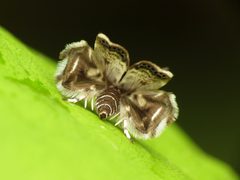
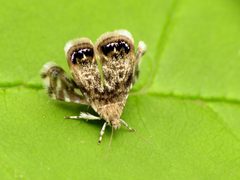
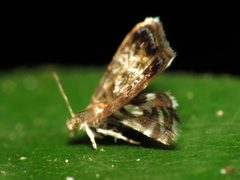
Brenthia is a of small in the Choreutidae, commonly known as peacock moths. The genus is notable for its caterpillars' remarkable defense strategy: they construct escape holes in leaves and use silken pillars to drop to safety when threatened. Some exhibit striking wing patterns that mimic jumping spiders, a form of mimicry. Brenthia species are associated with specific plants, with larvae feeding on various plant families including Boraginaceae and Malvaceae.
Pronunciation
How to pronounce Brenthia: /ˈbrɛn.θi.ə/
These audio files are automatically generated. While they are not always 100% accurate, they are a good starting point.
Identification
in this are small with distinctive wing patterns. Some display bold, contrasting markings on the hindwings that, when displayed, resemble the and legs of an oncoming jumping spider. This mimicry is visible when the moth is viewed from behind with wings spread. The caterpillars construct characteristic escape holes in leaves and produce silken pillars for dropping to safety.
Images
Habitat
varies by ; recorded from Mauritius below 1,500 feet elevation where plants grow, and from China where associated with Grewia species.
Distribution
Recorded from Mauritius (B. leptocosma), China (B. yangi), and the West Indies; broader distribution likely reflects that of specific plants.
Diet
Larvae feed on specific plants: Cordia macrostachya, C. myxa, C. abyssinica, and C. holstii (Boraginaceae) for B. leptocosma; Grewia biloba and G. biloba var. parviflora (Malvaceae) for B. yangi.
Host Associations
- Cordia macrostachya - primary larval plant bush in Mauritius; B. leptocosma feeds on this plant
- Cordia myxa - larval plantUnimportant tree; for B. leptocosma
- Cordia abyssinica - larval plantUnimportant tree; for B. leptocosma
- Cordia holstii - larval plantUnimportant tree; for B. leptocosma
- Grewia biloba - larval plant for B. yangi
- Grewia biloba var. parviflora - larval plant for B. yangi
Life Cycle
Larvae pass through five instars (I–V). I–II instar larvae show no significant preference for escape hole position in leaves. III–V instar larvae significantly prefer to set escape holes along main , with the size of the silken pillar determining hole position. The corner of two veins is not always the most preferred position for older larvae.
Behavior
Caterpillars construct escape holes in leaves and use silken pillars to drop to safety when threatened. This is more refined in older instars, which show specific preferences for hole placement along leaf . Some exhibit a dramatic anti- display: when threatened, they raise their wings to reveal patterns mimicking the and legs of a jumping spider.
Ecological Role
Larval and pupal have been recorded. B. leptocosma is extremely abundant where its plant Cordia macrostachya grows, but is of no value as a agent due to its mode of life. The 's abundance is tied to the excessive growth of its host plant.
Human Relevance
B. leptocosma is associated with an agricultural pest plant (Cordia macrostachya) in Mauritius, but has no value as a agent. The is of scientific interest for its remarkable mimicry and larval escape .
Similar Taxa
- Other ChoreutidaeSimilar small size and leaf-mining or leaf-rolling habits; Brenthia distinguished by escape hole construction and in some by jumping spider mimicry on hindwings
- Metalmark moths (Brenthia)The Brenthia itself contains with documented jumping spider mimicry; this should be clarified as intra-generic similarity rather than comparison with other
More Details
Predator Mimicry
Brenthia exhibit one of the most remarkable cases of mimicry known in Lepidoptera. When viewed from behind with wings spread, the hindwing patterns create the illusion of a jumping spider's and front legs, complete with arrangement and . This was formally documented in 2006 and represents a sophisticated evolutionary defense against spider .
Escape Hole Construction
The larval of constructing escape holes and silken pillars is unique among Choreutidae and represents a highly specialized defense mechanism. Statistical analysis shows that older larvae (III–V instar) develop specific preferences for hole placement along leaf main , while younger larvae show no such preference.
Sources and further reading
- BugGuide
- Wikipedia
- GBIF taxonomy match
- iNaturalist taxon
- NCBI Taxonomy
- Catalogue of Life
- Bug Eric: A Case of Predator Mimicry in the Bee Fly Genus Epacmus? (Diptera: Bombyliidae)
- Brentidae | Beetles In The Bush
- October | 2011 | Beetles In The Bush
- weevils | Beetles In The Bush | Page 2
- Brenthia yangi sp. nov. and its immature stages (Lepidoptera: Choreutidae: Brenthiinae)
- The Bionomics and Morphology of Brenthia leptocosma Meyrick (Lep., Glyphipterygidae)