
Paratrea plebeja
Fabricius, 1777
Trumpet Vine Sphinx, Plebeian Sphinx Moth
Paratrea plebeja, the Trumpet Vine Sphinx or Plebeian Sphinx Moth, is the sole member of its in the Sphingidae. This hawk moth is distributed across the eastern United States and Great Plains. The is strongly associated with trumpet vine (Campsis radicans), which serves as its primary larval plant. are and , with a period spanning late spring through summer.
Pronunciation
How to pronounce Paratrea plebeja: /ˌpærəˈtriːə pləˈbiːdʒə/
These audio files are automatically generated. While they are not always 100% accurate, they are a good starting point.
Identification
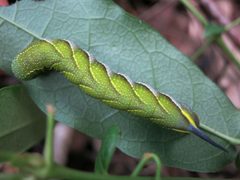
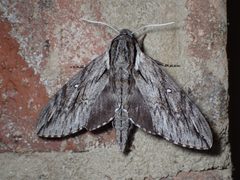
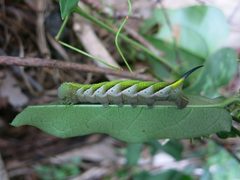
Distinguished from similar gray-brown sphingids by the combination of dull orange-brown hindwings (not bright pink or yellow) and the specific forewing pattern with a prominent discal spot. Smaller than most common Hyles and Manduca . The larva is green with pale diagonal stripes and a horn, resembling other sphingid caterpillars but found specifically on trumpet vine.
Images
Appearance
have a wingspan of approximately 45–55 mm. Forewings are gray-brown with darker brown markings, including a distinct discal spot and wavy transverse lines. Hindwings are dull orange-brown with a darker marginal band. The body is robust and streamlined, typical of sphingid , with a furry . The tapers to a point. are thickened toward the tips but not strongly clubbed.
Habitat
Open woodlands, forest edges, riparian corridors, and suburban areas where trumpet vine (Campsis radicans) grows. Often found near streams, roadsides, and fences where the vine climbs. frequent gardens and areas with abundant nectar sources.
Distribution
Eastern United States from the Atlantic coast westward through the Great Plains. Documented from Nebraska, Kansas, Oklahoma, and eastern Texas northward to southern Canada. Absent from most of the western United States.
Seasonality
fly from late May through August, with peak activity in June and July. Multiple occur per year in the southern part of the range; fewer in the north.
Diet
Larvae feed exclusively on trumpet vine (Campsis radicans). have been observed nectaring at various flowers including honeysuckle (Lonicera), phlox, and petunia.
Host Associations
- Campsis radicans - larval Primary and likely obligate plant
Life Cycle
Complete with , larva, pupa, and stages. Larvae pupate in soil or leaf litter. stage is the pupa.
Behavior
are strong, fast fliers active at dusk and night. They hover while feeding at flowers, with a rapid wingbeat. Attracted to artificial light. Larvae feed exposed on plant foliage.
Ecological Role
serve as for and flowering plants. Larvae act as herbivores, potentially regulating trumpet vine . Serves as prey for bats, birds, and other .
Human Relevance
Occasionally considered a minor pest when larvae defoliate ornamental trumpet vines. are attracted to outdoor lighting. Of interest to lepidopterists and naturalists due to its specialized association and status as the only member of its .
Similar Taxa
- Hyles lineataSimilar size and period, but has pink hindwings and more variable forewing pattern; larvae feed on diverse plants including evening primrose
- Sphecodina abbottiiSimilar gray-brown forewings, but hindwings are yellow-orange with a more contrasting pattern; associated with grape and Virginia creeper
- Darapsa myronSmaller with more uniform gray-brown coloration and less distinct forewing markings; larvae feed on grape and ampelopsis
More Details
Taxonomic notes
Paratrea plebeja is the only in the Paratrea, making it phylogenetically distinctive among North American Sphingidae. The genus was established to accommodate this species based on larval and morphological traits that separate it from related genera.