
Sphecodina abbottii
Swainson, 1821
Abbott's sphinx
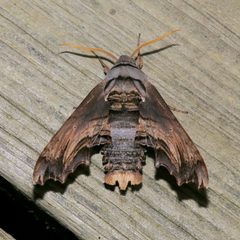
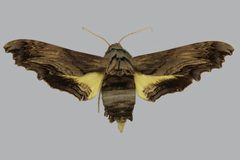
Abbott's sphinx is a North American hawk moth notable for its -mimicking and highly cryptic larval camouflage. display violet-grey forewings with bark-like patterning and yellow-banded underwings. The caterpillars exhibit remarkable , with some forms mimicking grapes while others resemble dead wood.

Pronunciation
How to pronounce Sphecodina abbottii: //sfɛk.oʊˈdaɪ.nə əˈbɒt.i.aɪ//
These audio files are automatically generated. While they are not always 100% accurate, they are a good starting point.
Identification
distinguished from other sphinx moths by combination of violet-grey forewings with bark-like black line patterning and prominent yellow underwing band. Larvae identified by rear knob (not horn) resembling vertebrate with white reflection spot; polymorphic coloration (green-spotted or wood-grain brown) with rear eyespot. Defensive squeaking and biting when disturbed is diagnostic.
Images
Habitat
Associated with woodland and forest edge where larval plants (grape and related vines) occur. observed resting on tree bark.
Distribution
Central and eastern North America. Absent from most of Florida. Records from Vermont and throughout eastern United States and adjacent Canada.
Seasonality
active May and June in northern portions of range; multiple per year in southern portions.
Diet
Larvae feed on grape (Vitis), Virginia creeper (Parthenocissus quinquefolia), and peppervine (Ampelopsis). feeding habits not documented.
Host Associations
- Vitis - larval grape
- Parthenocissus quinquefolia - larval Virginia creeper
- Ampelopsis - larval peppervine
Life Cycle
Complete with multiple annually in south, single generation in north. Early instars possess horn, replaced by knob in later development.
Behavior
produce buzzing resembling bees. When at rest, raise to enhance bark-camouflage. Larvae respond to tactile disturbance by squeaking and biting.
Ecological Role
Larval herbivore on native and cultivated vines. may contribute to pollination, though specific role undocumented.
Human Relevance
Larvae feed on cultivated grapes, potentially causing minor agricultural impact. Otherwise not significant to human interests.
Similar Taxa
- Other Sphecodina species contains few ; S. abbottii distinguished by distribution and specific wing patterns
- Other MacroglossinaeYellow underwing band and bark-patterned forewings separate from many congenerics; larval -spot knob is distinctive
More Details
Defensive mimicry
Larval appears adaptive: green-spotted form may mimic grapes among foliage, brown form resembles dead wood. The vertebrate -like knob may function in startle defense against .
Acoustic defense
Squeaking in larvae is relatively unusual among Lepidoptera and represents an acoustic startle or aposematic signal.