
Pachodynerus erynnis
(Lepeletier, 1841)
Red-marked Pachodynerus Wasp, Red and Black Mason Wasp
Pachodynerus erynnis is a solitary mason wasp that specializes in hunting caterpillars to provision its nests. Unlike social , it does not form colonies but constructs individual nests in pre-existing cavities. The is valued as a agent, targeting economically significant caterpillar pests including armyworms, cutworms, and loopers. Its frequent visits to flowers for nectar make it a minor as well.
Pronunciation
How to pronounce Pachodynerus erynnis: //ˌpækoʊˈdaɪnərəs ˈɛrɪnɪs//
These audio files are automatically generated. While they are not always 100% accurate, they are a good starting point.
Identification
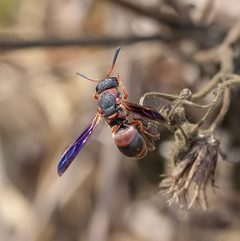
The can be distinguished from the similar Pachodynerus nasidens by its coloration: P. erynnis has red markings on a black background, whereas P. nasidens displays yellow and black banding that mimics the Mexican Honey Wasp (Brachygastra mellifica). The red and black pattern of P. erynnis lacks the extra yellow stripe across the front of the seen in P. guadulpensis.
Images
Habitat
Nests in holes or crevices of trees, man-made structures, and abandoned nests of other cavity-nesting bees and . Often found in areas with flowering plants near suitable nesting cavities.
Distribution
Native to North America. Documented observations span much of the eastern and central United States, with records from Florida and northward through the eastern seaboard and into the Midwest.
Diet
Specialized of caterpillars (Lepidoptera larvae), including armyworms (Spodoptera spp.), cutworms (Agrotis spp.), and loopers (Noctuoidea). consume nectar from flowers.
Life Cycle
Females construct solitary nests in pre-existing cavities, provisioning each with multiple paralyzed caterpillars. An is laid in the cell, which is then sealed with mud. Larvae develop by consuming the stored caterpillars. Gender control has been observed in related mason wasps, with male eggs placed closer to the nest entrance to facilitate earlier .
Behavior
Females inspect and clean potential nest sites before accepting them. They hunt caterpillars on flowers, foliage, vegetables, and fruit, paralyzing prey with venom. Multiple caterpillars (up to 19 or more per ) are captured and stored as larval food. Nest entrances are sealed with mud plugs. are rapid fliers and frequently visit flowering plants, particularly mountain mint (Pycnanthemum) and spotted horsemint (Monarda).
Ecological Role
agent that reduces of herbivorous caterpillar pests in managed and natural landscapes. Contributes to minor pollination through nectar foraging.
Human Relevance
Considered highly beneficial in agricultural and horticultural settings due to on pest caterpillars. May utilize artificial nesting structures such as houses and drilled wooden blocks. No documented negative impacts; stings are possible but unlikely given its solitary, non-aggressive nature.
Similar Taxa
- Pachodynerus nasidensYellow and black banding versus red and black coloration; P. nasidens is a mimic of the Mexican Honey Wasp
- Pachodynerus guadulpensisHas an extra yellow stripe across the front of the that P. erynnis lacks
- Monobia quadridensAnother black and white mason wasp in the same (Eumeninae) with similar nesting habits but different color pattern
More Details
Nesting Behavior
Females demonstrate nest site fidelity to pre-existing cavities rather than excavating new ones, making them dependent on wood-boring beetles, carpenter bees, or human-provided nesting structures.
Pest Control Value
Has been specifically associated with increased pest control in managed landscapes, with documented on economically damaging noctuid larvae.
Sources and further reading
- BugGuide
- Wikipedia
- GBIF taxonomy match
- iNaturalist taxon
- NCBI Taxonomy
- Catalogue of Life
- Paralyzing prey in Paradise: Keyhole wasp, Pachodynerus nasidens — Bug of the Week
- Bug Eric: February 2011
- Bug Eric: Spring (Butterfly) Beauties
- Oedemeridae | Beetles In The Bush
- On the prowl to paralyze pests here in the DMV: Four-toothed mason wasps, Monobia quadridens — Bug of the Week
- Red and black mason wasp, Pachodynerus erynnis (Lepeletier)