
Ancistrocerus albophaleratus
(de Saussure, 1855)
White-banded Potter Wasp
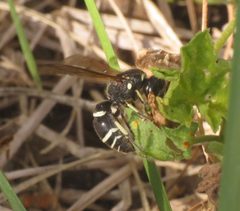
Ancistrocerus albophaleratus is a solitary mason wasp in the Eumeninae, commonly known as the White-banded . Like other Ancistrocerus , it is a cavity-nesting that constructs nests using mud in pre-existing hollows. The species is part of a characterized by distinctive morphological traits including a transverse carina on the first abdominal segment. It is native to North America with confirmed records in the northeastern United States.
Pronunciation
How to pronounce Ancistrocerus albophaleratus: //ænˌsɪstroʊˈsɪərəs ˌælboʊfələˈreɪtəs//
These audio files are automatically generated. While they are not always 100% accurate, they are a good starting point.
Identification
Members of the Ancistrocerus can be identified by a prominent transverse carina (ridge) on the base of the first abdominal segment (T1), creating an abrupt angle that the rear of the . For A. albophaleratus specifically, the specific color pattern of white or pale markings on the distinguishes it from ; the epithet "albophaleratus" refers to these white banded markings. Males have hooked tips on their , a characteristic shared with many male eumenine .
Images
Habitat
Found in woodland and forest edges, particularly where suitable nesting substrates and prey resources are available.
Distribution
Recorded from Vermont and other parts of the northeastern United States. GBIF distribution records indicate presence in the US, specifically Vermont-US.
Diet
feed on nectar, honeydew, and other -rich liquids. Larvae are provisioned with paralyzed caterpillars, as is typical for the .
Life Cycle
Females nest in pre-existing cavities such as old borings in logs, hollow twigs, or abandoned mud dauber nests. They construct multi-celled nests using mud partitions, provisioning each with paralyzed caterpillars before laying an . The egg is typically suspended from the cell roof by a silken thread before prey is added.
Behavior
Females hunt caterpillars on foliage, paralyzing them with stings to serve as fresh food for developing larvae. They collect water and soil to form mud for nest construction, showing preferences for specific soil types. The may spend the night in unfinished nest .
Ecological Role
As a of caterpillars, this contributes to natural pest control in woodland . It also serves as a potential for including bee flies (Toxophora) and eulophid (Melittobia), and may be preyed upon by wedge-shaped beetle larvae (Macrosiagon).
Human Relevance
Like other solitary , poses minimal sting risk and is generally non-aggressive. Contributes to garden and woodland health through caterpillar .
Similar Taxa
- Ancistrocerus waldeniiAlso constructs free-form mud nests on hard surfaces, but A. waldenii has white markings on T1-T5 and a spot on T6, with entirely black in females.
- Ancistrocerus unifasciatusSimilar size and use, but A. unifasciatus has limited yellow markings restricted to , base, base, and legs; males have large yellow facial patches.
- Ancistrocerus campestrisOverlapping range and similar nesting , but A. campestris has yellow hind margins on the first three abdominal segments.
Sources and further reading
- BugGuide
- GBIF taxonomy match
- iNaturalist taxon
- NCBI Taxonomy
- Bug Eric: Wasp Wednesday: Walden's Mason Wasp, Ancistrocerus waldenii
- Bug Eric: How to (Almost) Catch a Leaf-tier Caterpillar (Video)
- Bug Eric: How to Catch a Leafroller Caterpillar (Video)
- Bug Eric: Eight Illinois Wasp and Bee Mimics in Twenty Minutes
- Bug Eric: City Nature Challenge 2023 Recap